


Excess Inventory Management: How to Cut Storage Costs and Avoid Obsolescence
Slow-moving inventory kills fulfillment economics. It ties up cash, burns pallet positions, adds touches, and drags down throughput. If you’re scaling SKUs or ramping up retail channels, you need a clear excess inventory management playbook. Here’s how we run it as a 30-year Atlanta 3PL, what it costs, the SLAs to demand, and the risks to watch.
Excess inventory ties up capital, racks up storage fees, and risks markdowns if products become obsolete. For DTC founders, retail marketers, and procurement leaders, effective excess inventory management improves cash flow and operational efficiency. Here’s how an experienced 3PL runs this process, what it costs, and the risks you need to watch.
What Is Excess Inventory Management and When to Use It?
Excess inventory management is the ongoing process of identifying, isolating, and reducing stock that’s sitting beyond immediate demand. It’s not a once-a-year cleanup. It’s a weekly discipline embedded in your warehouse management system (WMS) and replenishment process.
Why It Matters
Cash: Every pallet of slow movers ties up capital you can’t invest in winning SKUs. Onramp Funds notes that inventory sitting too long deadlocks working capital (https://www.onrampfunds.com/resources/cost-inventory-sitting-too-long-shelf).
Space: Storage, counting, and moving costs add up. Excess inventory blocks pick paths and slows fast SKUs, increasing congestion and labor costs per unit.
Risk: Aging stock risks damage, expiration, or markdowns to clear. Ligentia highlights rapid product obsolescence risks, especially in seasonal markets (https://ligentia.com/blog/hidden-costs-of-excess-inventory-how-to-protect-your-bottom-line/).
Labor drag: More cycle counts and forklift moves without added sales slow throughput and increase operational overhead.
When to Act
Act after a SKU velocity review shows 30+ days on hand without a sell-through plan; during seasonal transitions where last season’s variants linger; after post-launch forecast misses; and during channel shifts (e.g., Amazon to DTC, retail resets) that strand packout-specific SKUs.
Use Cases
DTC brands with SKU sprawl (size/color variants, changing promos); B2B brands with long lead times or MOQs that overfill racks; and teams adding new products without cleaning out old ones. Pull Logic emphasizes the costly consequences of overstocking and the need for agility (https://pulllogic.com/resources/the-costly-consequences-of-inventory-overstocking-2/).

Step-by-Step Excess Inventory Management Workflow
Start with the data to fix the floor. This is the cadence we run and recommend.
1) Weekly SKU velocity and aging review: Pull a 13-week demand history alongside an aging report by SKU, lot, and expiration. Flag slow (>45 days on hand), dead (no movement in 60+ days), and fast (15–30 day turns, adjusted per category). If your WMS can’t deliver this, you’re guessing. This routine analysis helps uncover slow-moving or dead stock before it becomes a capital sink.
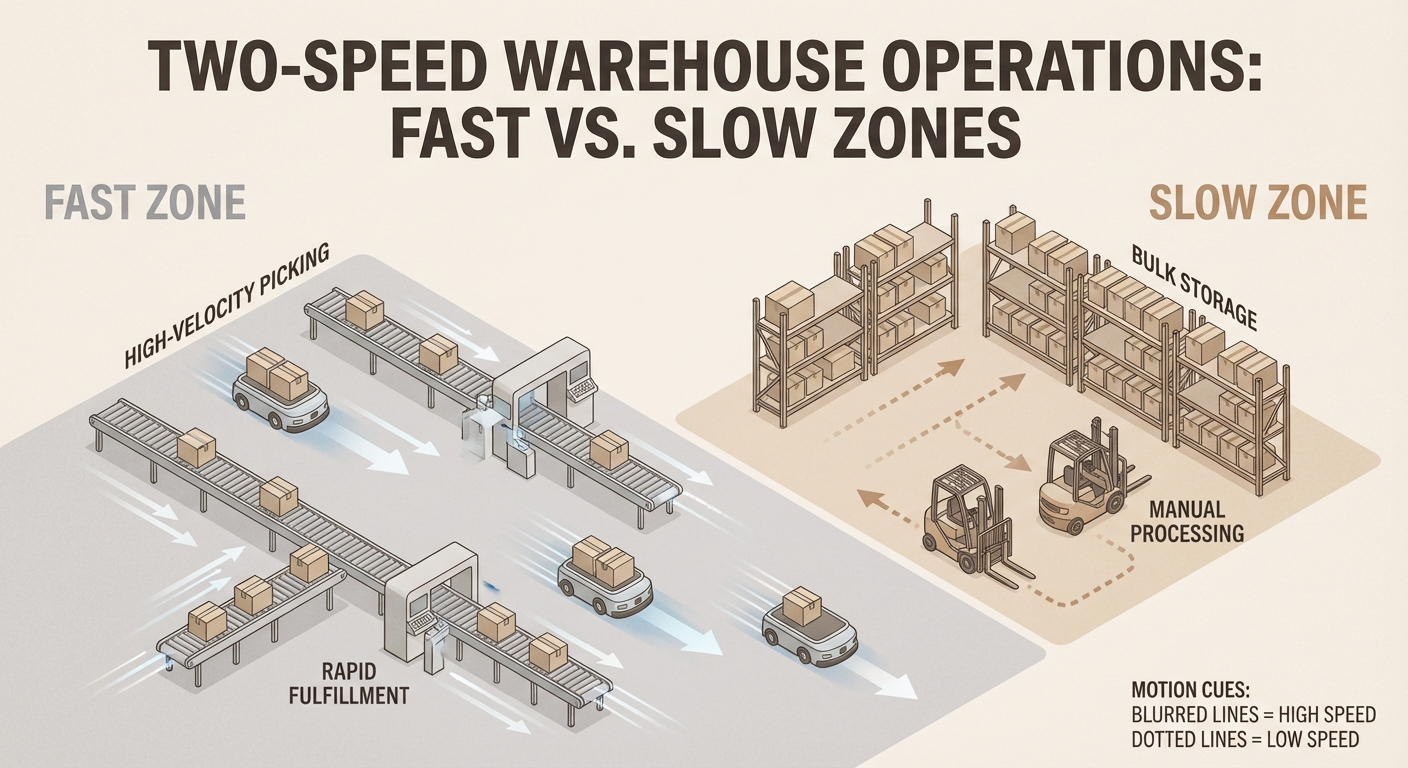
2) Segment SKUs and set rules: Tag SKUs as A/B/C or Fast/Slow/Dead to drive slotting, pick logic, and replenishment controls. Fast SKUs should be in forward pick faces near packing with frequent top-off; slow/dead SKUs belong in high-bay or reserved overflow to free prime slots.
3) Dedicated storage zones for excess: Isolate slow and dead stock in labeled zones to prevent bleed into pick paths. Use palletized storage (one pallet, one location) to reduce mispicks.
4) Replenishment and reorder controls: Tighten reorder points and minimums on slow movers. Use vendor scorecards where MOQs force excess; negotiate assortments or pre-kitted bundles.
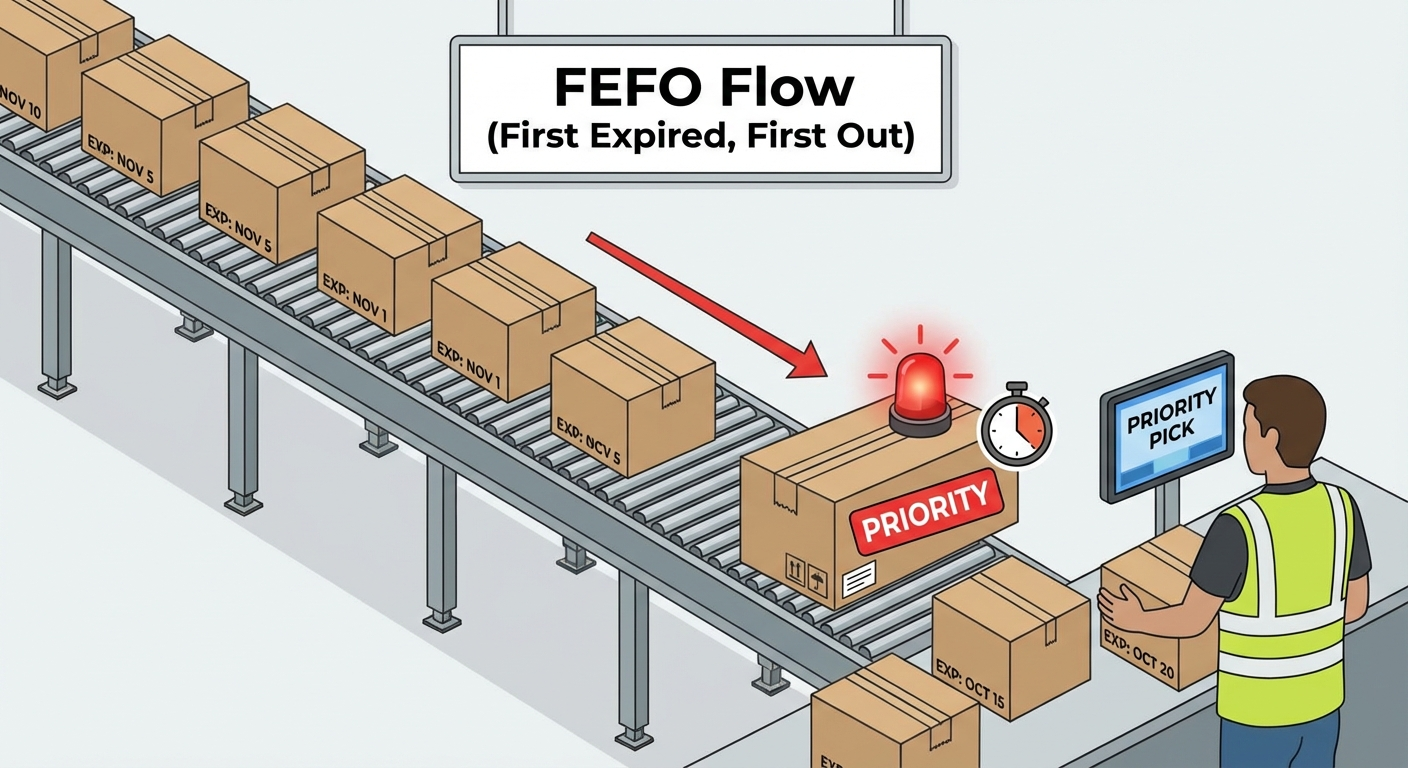
5) Pick logic to prevent obsolescence: Use FIFO as standard and FEFO (First-Expire-First-Out) for dated goods, cosmetics, and perishables. Hard-code FEFO rules in your WMS; don’t rely on picker judgment.
6) Inventory accuracy discipline: Perform weekly cycle counts on slow movers by zone. Targets: ≥99.5% inventory accuracy and ≥99.0% location accuracy. Complete dock-to-stock within 24 hours so aging clocks start with accurate data, not estimates.
7) Kitting or bundling to move units: Build promo bundles, mystery packs, or BOGO kits to reduce excess without liquidation. Batch kitting runs of 250–1,000 units with pre-labeled components help control labor costs.
8) Returns, refurbishment, and liquidation: For truly dead stock, stop paying storage fees. Route to returns-to-stock (if resellable), refurbishment/repacking for secondary channels, or donation/recycling/liquidation partners. Base decisions on carrying cost versus expected recovery.
9) Weekly cross-team communication: Share a one-page summary with marketing and procurement listing slow/dead SKUs, aging data, planned bundles, and liquidation triggers to align product, finance, and operations.
Implementing this workflow requires disciplined SOPs and an operational mindset that prevents costly mistakes and reduces hidden costs (Lowry Solutions: https://lowrysolutions.com/blog/excess-inventory-explained-causes-effects-and-solutions/).
Key KPIs and SLAs for Managing Excess Inventory
Track these to measure success. Your 3PL should commit to SLAs here or risk operational drift.
Inventory accuracy — Target: ≥ 99.5% — Why: Accurate decisions require good counts.
Location accuracy — Target: ≥ 99.0% — Why: Reduces pallet hunting and pick delays.
Dock-to-stock time — Target: ≤ 24 hours — Why: Provides near real-time visibility.
Order cycle time — Target: 24–48 hours — Why: Keeps outbound shipping predictable.
On-time storage billing — Target: 100% — Why: Enables clean, accurate cost control.
Excess inventory ratio — Target: <10% of units or <15% of value — Why: Limits tied-up capital.
Cycle count completion — Target: 100% to schedule — Why: Avoids surprises and inventory errors.
These metrics align with best practices for slow-moving inventory management (Inbound Logistics: https://www.inboundlogistics.com/articles/slow-moving-inventory/).

Pricing Drivers for Excess Inventory Management
Excess stock impacts costs beyond just storage fees. Key pricing drivers include storage tier (pallet/rack vs bins), turnover velocity (holding period), handling touches (moves/counts/audits), cycle count frequency (labor vs accuracy), kitting or repackaging (labor/materials), inbound profile (micro-receipts, mixed SKUs, labeling quality), seasonal spikes (temporary overflow and short-term labor), and network footprint (Atlanta’s 2-day ground reach to ~80% of U.S. households can reduce expedited shipping when moving excess).
Good excess inventory management balances holding costs against kitting and labor to optimize cost-to-serve. The financial risks of overstocking are detailed by Pull Logic (https://pulllogic.com/resources/the-costly-consequences-of-inventory-overstocking-2/).
Risks and Mitigations in Excess Inventory Management
Risk: Overstocking ties up cash and space. Mitigation: Enforce reorder points, approvals on buys outside forecasting, and weekly velocity reviews.
Risk: Obsolescence and markdowns. Mitigation: Use FEFO picking, time-box promo windows, and enact liquidation rules at 60/90/120 days of aging.
Risk: Miscounts lead to stockouts on fast SKUs and inventory bloat with slow SKUs. Mitigation: Conduct daily cycle counts on A-movers, weekly on slow zones, and require ≥99.5% accuracy SLAs.
Risk: Labor drag from excess handling. Mitigation: Schedule batch kitting, counts, and relocations in fixed time blocks to protect core pick/pack workflows.
Risk: Floor congestion reduces throughput. Mitigation: Hard-isolate excess inventory in high-bay storage to protect prime pick lanes.
Risk: Promo math excludes operational costs. Mitigation: Model full landed margins including kitting labor, materials, pick fees, and postage; avoid BOGOs that lose money after handling costs.
Proactive mitigation is critical to controlling the financial and operational impacts of excess inventory (Lowry Solutions: https://lowrysolutions.com/blog/excess-inventory-explained-causes-effects-and-solutions/).

Atlanta Advantage: Speed and Cost Efficiency for Excess Inventory Management
Ship speed drives sell-through: Atlanta’s central location enables 2-day ground delivery to roughly 80% of U.S. households, supporting promotions without air freight.
Simplified network: A centralized node reduces safety stock spread across coasts, limiting stranded inventory and split shipments.
Transit economics: Strong Southeast freight lanes lower total transportation costs when margins tighten on clearance inventory.
Scalable labor: Regional labor markets support seasonal kitting sprints and re-slotting without inflating per-unit costs.
All Points’ Atlanta location leverages these advantages to reduce storage time and obsolescence risk.
What You Get with All Points for Excess Inventory Management
Custom bundling to move slow SKUs: Planning, sourcing materials, and building promos/sets via custom kitting and assembly services (https://www.allpointsatl.com/services/custom-kitting-product-assembly).
Inventory accuracy discipline: SOP-driven receiving, slotting, and cycle counts with an inventory accuracy focus in warehousing and distribution (https://www.allpointsatl.com/services/warehousing-distribution).
Print and pack alignment: Inserts, sleeves, labels, and kit components produced onsite to keep promo timelines on track.
Operator-grade reporting: Weekly slow/dead lists, aging by SKU/lot, and disposition plans so procurement and marketing can act.
Floor protection: Excess inventory is isolated to prevent choking the fastest pick paths.
30 years in Atlanta: Family-owned since 1995; scaled kitting runs into tens of thousands while maintaining accuracy through volume surges.
How Slow-Moving Inventory Hurts Fulfillment Economics (And What To Do)
On the floor, slow-moving inventory lengthens pick paths, inflates touches (relocates/recounts), blocks receiving (delaying putaway and causing dock-to-stock issues), degrades accuracy (more locations, more errors), and burns promo windows (late kitting/re-slotting misses sales opportunities).
Operator fixes that work
Run and act on weekly slow/dead lists; reports matter only if they change floor plans.
Protect pick faces by prioritizing shortest paths for fast movers and moving slow stock to high-bay.
Time-box promos and kitting in 2–3 day sprints using pre-kitted components and labeled packs.
Hard-code FEFO in the WMS; don’t rely on tribal knowledge.
Lock reorder points until on-hand stock hits target levels.
Implementation Timeline We Recommend
Week 1: Data pull, velocity/aging segmentation, set disposition rules, label slow/dead zones, start cycle counts in these zones.
Week 2: Re-slot fast movers, move slow to overflow, implement FEFO picks, launch weekly excess inventory report to procurement and marketing.
Week 3: Launch first kitting/bundle sprint; begin liquidation for Tier-3 dead stock.
Ongoing: Weekly reviews, monthly KPI checks, quarterly assortment cleanups.
Call to Action
Get a kitting quote for bundles that reduce excess: https://www.allpointsatl.com/services/custom-kitting-product-assembly
Download our comprehensive 3PL guide if you’re evaluating fulfillment partners: https://www.allpointsatl.com/resources/3pl-guide-for-e-commerce-and-amazon-sellers
FAQ
What causes excess inventory? Overbuying based on optimistic forecasts, MOQs exceeding sell-through, SKU sprawl from rapid launches, and weak end-of-life planning. Poor slotting and weak WMS discipline worsen the problem.
How does excess inventory impact costs? It drives monthly storage fees, increases cycle counts and forklift moves, and leads to markdowns, damage, and obsolescence. It also slows throughput on fast-moving SKUs.
What KPIs should I track for excess inventory management? Inventory accuracy (≥99.5%), location accuracy (≥99.0%), dock-to-stock time (≤24 hours), order cycle time (24–48 hours), and excess inventory ratio (<10–15% of on-hand value). Also track cycle count completion.
How quickly can excess inventory be turned over? With disciplined kitting and promotions, plan for material reduction within 30–60 days. Truly obsolete SKUs should be liquidated within 90 days to stop storage costs.
What does it cost to manage excess inventory with a 3PL? Costs vary based on pallet positions, handling touches (counts, relocations), labor and materials for kitting, and audit frequency. Early prevention through tight reorder points and weekly reviews is the most cost-effective approach.
What SLAs should my 3PL commit to? Inventory accuracy ≥99.5%, dock-to-stock ≤24 hours, on-time shipping ≥99%, cycle count adherence 100%, and documented FEFO compliance for dated goods.
How fast can All Points implement this workflow? Typical rollout is 2–3 weeks: week 1 for data and zoning, week 2 for re-slotting and WMS rules, week 3 for kitting and clearance. Complex catalogs may require an additional week for data and labeling setup.
Disclaimer
All Points is an Atlanta-based, family-owned 3PL founded in 1995. We deliver end-to-end logistics—from custom kitting and ecommerce fulfillment to warehousing, distribution, and printing—so your brand ships accurately, on time, and at scale. Talk to us when you want operator-grade excess inventory management tied to real SLAs and clean execution.
Further Reading
For deeper dives on costs and operational tradeoffs, see: Onramp Funds (https://www.onrampfunds.com/resources/cost-inventory-sitting-too-long-shelf), Ligentia (https://ligentia.com/blog/hidden-costs-of-excess-inventory-how-to-protect-your-bottom-line/), Pull Logic (https://pulllogic.com/resources/the-costly-consequences-of-inventory-overstocking-2/), Inbound Logistics (https://www.inboundlogistics.com/articles/slow-moving-inventory/), Lowry Solutions (https://lowrysolutions.com/blog/excess-inventory-explained-causes-effects-and-solutions/).
Conclusion
Cutting storage costs and avoiding obsolescence starts with disciplined excess inventory management: weekly SKU reviews, smart slotting, FEFO picking, and strategic kitting. With real-time data, clear SLAs, and Atlanta’s logistics edge, brands free up cash, optimize space, and boost fulfillment efficiency.
.webp)
.webp)
.webp)
.webp)
.webp)


