


Rural last mile delivery costs: What DTC brands need to know
Rural last mile delivery costs can quickly eat into your margins if you ship outside metro areas. If you sell direct-to-consumer (DTC) or B2B and your customers live in small towns, farm roads, or mountain communities, your route density is low and carrier surcharges apply. This guide explains why rural deliveries cost more, how workflows affect pricing, and what to watch for when comparing 3PLs or kitting partners.
What is rural last mile delivery and when does it apply?
The “last mile” refers to the final step of moving a parcel from warehouse to customer door. Rural last mile delivery specifically covers addresses outside urban centers — small towns, agricultural routes, unincorporated communities, and other low-density areas far from main corridors.
You encounter rural last mile delivery whenever an address triggers a carrier’s Delivery Area Surcharge (DAS), Extended Area Surcharge (EAS), or when local service is limited (fewer delivery days, long drive times, dirt roads). Rural deliveries are a distinct challenge because they bring a unique set of cost drivers and operational considerations.
Rural last mile delivery costs more than urban delivery because of several factors:
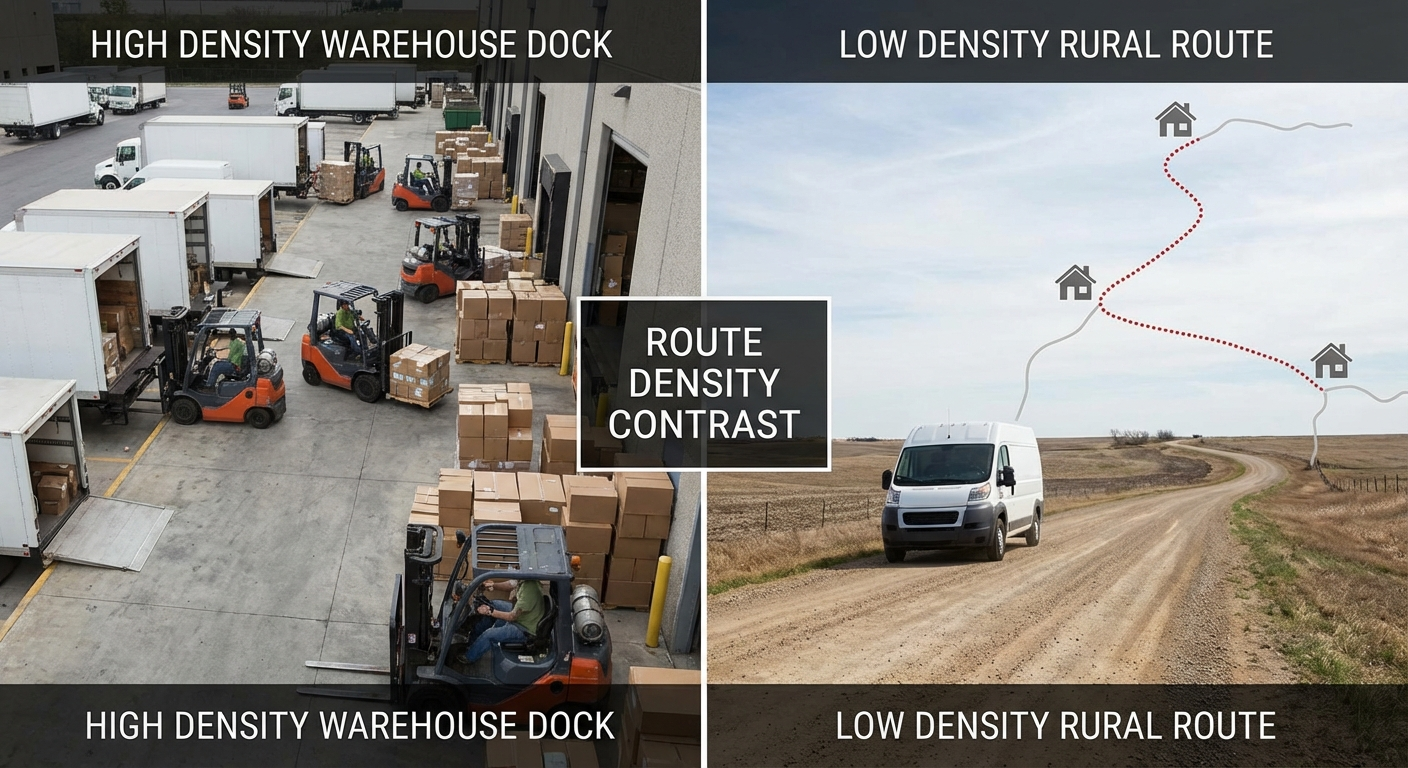
- Low stop density: A driver might complete 12–20 rural stops in the time an urban route sees 60–90 stops, raising the cost per stop dramatically.
- Longer distances: Remote routes mean more miles traveled, higher fuel consumption, and longer labor hours.
- Challenging infrastructure: Rural roads are often narrow, unpaved, or poorly marked, with limited cell coverage, increasing driver time and risk of misdeliveries.
- Routing inefficiency: Sparse addresses force less efficient routing with more “deadhead” miles where vehicles travel empty.
- Carrier surcharges: Major carriers add DAS/EAS fees and often assess additional residential surcharges for rural deliveries.
The combination of lower route density, extended travel distances, and infrastructure challenges define rural logistics, which directly impacts the total rural last mile delivery costs your brand faces.
For a detailed look at rural last mile delivery challenges and solutions: https://nuvizz.com/blog/last-mile-delivery-in-rural-areas-challenges-smart-solutions/

How rural last mile delivery workflows impact your operations
Managing rural last mile delivery requires a methodical, tailored workflow to keep costs manageable without sacrificing service. Here’s a step-by-step overview of the typical rural delivery process, designed to highlight operational nuances and how they affect pricing:
1) Order capture and batching: Early identification of rural addresses is critical. Use carrier flags (DAS/EAS) or zip code routing rules to segregate rural orders. Batch these orders by region and service level—for example, grouping orders headed to similar ZIP codes or transit zones. Hold batches until they reach a sufficient size or hit a cutoff time to optimize route density and reduce cost per package.
2) Kitting and packing by SKU density: Efficient kitting can significantly reduce packing time and freight costs. Bundle multi-SKU orders into compact kits so pickers only need to grab one pre-made set per order instead of multiple individual items. Use right-sized cartons and inserts to minimize dimensional weight fees. This strategy reduces wasted space and protects contents from damage during demanding rural transit.
Our full-service kitting & assembly process helps brands optimize pack density and cut down on dimensional weight surcharges. Learn more: /services/kitting-assembly
3) Staging and handoff: Pre-stage rural batches in a dedicated outbound lane. Validate and clean addresses to minimize re-labeling or reroute errors. Rural shipments often require coordination with regional carriers or postal conversion services (e.g., UPS SurePost), which can reduce last mile delivery costs while accepting slightly extended delivery timelines.
4) Routing and dispatch: Ship rural batches on a regular cadence (for example, three times per week) to balance fulfillment SLAs against batch density. For higher-density rural areas, linehaul packages to regional cross-docks where local carriers can execute shorter routes, lowering miles per delivery.
5) Delivery exceptions and retries: Remote addresses sometimes cause delivery attempts to fail due to incomplete directions, gated properties, or P.O. boxes. Automated address correction software and geocoding can improve accuracy. Expect and accommodate a slightly higher reattempt rate versus metro deliveries. Proactive communication via SMS or email can alert customers to delivery windows and reduce missed deliveries.
Operational bottlenecks to watch:
- Inconsistent batch sizes due to lower order velocity can spike costs if small lots ship prematurely.
- Packing errors or overlooked SKU dimensions risk overpaying dimensional weight fees.
- Inbound receiving may be deprioritized to meet rural outbound deadlines, risking inventory accuracy. Maintaining inbound SLAs is critical.
Our teams utilize ecommerce fulfillment with operational transparency and strict SLA adherence to navigate these challenges effectively. See more: /services/e-commerce-order-fulfillment
Additional insights: https://www.custom-goods.com/newsroom/why-last-mile-delivery-matters-more-than-ever

Key KPIs and SLAs for rural last mile delivery
Managing expectations with measurable KPIs and realistic SLAs is essential for rural last mile success.
KPI: Pick Accuracy | Typical rural range: 99.5%+ | What it means: Accurate picking prevents costly rural reships due to incorrect shipments.
KPI: Order Cycle Time | Typical rural range: 48–72 hours | What it means: Extended due to batching and longer transit times.
KPI: Dock-to-Stock Time | Typical rural range: ≤24 hours | What it means: Speed here supports timely batching and staging of rural orders.
KPI: On-Time Ship Rate | Typical rural range: 90–95% | What it means: Lower density and multiple handoffs increase delivery variability.
Setting SLAs aligned with rural complexity helps avoid costly surprises. All Points’ operator-grade discipline maintains error and delay rates at industry-best levels to support your brand.
More on last mile delivery KPIs and outlook: https://www.emarketer.com/content/faq-on-last-mile-delivery--how-final-step-of-fulfillment-will-take-shape-2026

What drives rural last mile delivery costs up or down?
Several factors specifically influence whether rural last mile delivery costs escalate or decline:
- Volume density per route: Fewer packages per stop increase per-delivery cost. To lower costs: Maintain consistent batch sizes and regional groupings to increase stops per route.
- Distance and fuel usage: Longer trips increase labor hours, fuel expenses, and maintenance costs. Mitigation: Linehaul to regional cross-docks closer to delivery zones reduces driver mileage.
- Infrastructure quality: Poor roads, gated communities, and unclear addresses add time and manual handling costs. Mitigation: Use address validation, geocoding, and clear shipping instructions.
- Routing complexity: Mixing delivery service classes or dispersed ZIP codes complicates routing, increasing deadhead miles. Best practice: Plan delivery waves by service class and cluster ZIP codes for route optimization.
- Weather and seasonality: Rural routes face weather-related delays more frequently. Solution: Buffer SLAs and flexible carrier partnerships help mitigate disruptions.
- Packaging efficiency (DIM/cube): Oversized or poorly packed cartons raise dimensional weight fees. Solution: Use right-sized boxes, nesting, and pre-kit kits to minimize shipping size.
Chasing the “cheapest” carrier often leads to a false economy. Low initial rates paired with higher failure or reship frequency inflate total rural delivery costs. Ensuring the first delivery is correct saves time and money.
Additional perspective: https://brightpathassociates.com/rural-ecommerce-order-fulfillment-solutions-for-remote-areas/
Risk factors with rural last mile delivery and how All Points mitigates them
Delivering to rural addresses presents risks that, unchecked, can amplify costs and reduce customer satisfaction. Here’s a look at key risk factors and the strategies All Points employs to counter them:
- Missed delivery windows: Due to distance and complex handoffs, rural routes can incur delayed ETAs. Mitigation: Fixed dispatch cadences, region-based carrier selection, and proactive notifications keep customers informed and reduce exceptions.
- Higher error rates from SKU complexity: SKU sprawl in rural waves introduces mispicks. Mitigation: Reduced SKU complexity through velocity-based slotting, color-coded labeling, and pre-kitted bundles.
- Increased labor costs from inefficient picks: Smaller rural batches cause more pick touches and longer labor cycles. Mitigation: Sequence rural picks after main waves and enforce single-touch pack processes.
- Infrastructure and damage risk: Rough transit environments cause higher damage rates. Mitigation: Use ISTA-certified packaging with reinforced corners, cushioning, and custom inserts.
- Poor address data quality: Incomplete or inaccurate addresses trigger returns and reships. Mitigation: Validate addresses at checkout, apply geocoding upon import, and collect delivery instructions like gate codes.
- Limited carrier visibility: Some local carriers provide sparse tracking. Mitigation: Aggregate tracking into a unified system and proactively alert customers for exceptions.
- Misclassification of commercial vs. residential shipments: This leads to unexpected surcharges. Mitigation: Automated detection systems and frequent audits reduce DAS charges and errors.
All Points leverages standardized SOPs, built-in SLAs, and a robust carrier network to keep rural last mile delivery risks to a minimum.

The Atlanta advantage for rural last mile delivery costs
All Points’ Atlanta location offers key strategic benefits for rural last mile delivery efficiency and cost control:
- Strategic central location: From Atlanta, nearly 80% of U.S. customers are reachable within two days ground transit. This accelerates rural deliveries in the Southeast, Mid-Atlantic, and parts of the Midwest, reducing reliance on costly air freight.
- Batch consolidation and smoothing: Regional cross-dock and linehaul capabilities reduce “lumpy” rural orders. Consolidating packages regionally enhances route density while maintaining SLA compliance.
- Local carrier expertise: Established relationships with national and regional carriers in Atlanta translate to reliable last 50-mile coverage for rural addresses.
- Integrated custom kitting reduces size: On-site kitting compresses cartons, cuts dimensional weight fees, and drops shipping costs.
- On-site printing and materials: Handling marketing collateral (instructions, promos, warranty cards) in the same facility reduces handling delays and enhances brand experience.
Leverage All Points’ warehousing and distribution from Atlanta to improve rural delivery speed and costs. Learn more: /services/warehousing-distribution
What you get with All Points
- Full-service kitting & assembly that maximizes rural pack efficiency: /services/kitting-assembly
- Ecommerce fulfillment with operational transparency to manage SLAs and reduce errors: /services/e-commerce-order-fulfillment
- Warehousing and distribution from Atlanta providing faster regional reach and batch density: /services/warehousing-distribution
- Printing & marketing materials integrated with kitting to ensure branded, cohesive packaging: /services/printing-marketing-materials
Practical tactics to cut rural cost per order
- Separate delivery classes in wave planning to avoid inefficient mixed routes (e.g., don’t mix 2-day and economy shipments within the same vehicle).
- Pre-kit common rural bundles to reduce pick time and improve packaging density.
- Limit the variety of carton types and standardize packaging sizes to lower dimensional weight fees.
- Validate addresses rigorously before label printing and collect detailed delivery instructions (gate codes, yard directions).
- Use postal conversion services when delivery speed can be traded for cost savings on last mile.
- Establish realistic SLAs aligned with batch cadence and routing density. Missed delivery promises often cost more than wider delivery windows.
- Account for seasonal weather by widening delivery windows and switching carriers as necessary.
FAQ
Q1: How do rural last mile delivery costs compare to urban deliveries?
A: Rural deliveries cost more due to DAS/EAS surcharges, lower stop density, longer drive times, and challenging infrastructure. Costs per delivered order are higher, and cycle times are longer. Well-planned batching and kitting can reduce but not eliminate this cost gap.
Q2: What SLAs can I expect for rural shipping through a 3PL?
A: Typical SLAs include 99.5%+ pick accuracy, on-time ship rates of 90–95%, and 48–72 hours from order to ship. Transit takes 3–6 days door-to-door, varying by location and service level.
Q3: Can kitting reduce costs on rural last mile deliveries?
A: Yes. Pre-kitting consolidates SKUs and reduces carton size and dimensional weight fees, helping cut both labor and shipping costs.
Q4: What is the typical order cycle time for rural shipments?
A: Ground or economy service rural shipments usually require 3–6 days from order to delivery, influenced by routing and batch cadence. Using linehaul hubs can reduce transit times without costly airfreight.
Q5: How does All Points’ Atlanta location affect rural delivery speed and cost?
A: Atlanta’s central location allows nearly 80% of U.S. addresses to be reached within two days ground, improving rural delivery speed and route density while lowering air freight dependency.
Get a clear picture of your rural last mile delivery costs and how to control them.
Start managing your rural delivery costs with expert help today:
- Get a kitting quote: /services/kitting-assembly
- Talk to an Atlanta 3PL expert: /contact
Secondary resource: Download the 3PL Guide for deeper insights into reducing fulfillment costs and improving SLAs: https://www.allpointsatl.com/resources/3pl-guide-for-e-commerce-and-amazon-sellers
About All Points
All Points is an Atlanta-based, family-owned 3PL founded in 1995. We deliver end-to-end logistics—from custom kitting and ecommerce fulfillment to warehousing, distribution, and printing—so your brand ships accurately, on time, and at scale.
Disclaimer: This article is for informational purposes only and does not constitute legal or financial advice. Contact All Points or your logistics advisor for specific guidance tailored to your business needs.
For rural last mile delivery insights and smart operational solutions, consider these additional resources:
- https://nuvizz.com/blog/last-mile-delivery-in-rural-areas-challenges-smart-solutions/
- https://www.custom-goods.com/newsroom/why-last-mile-delivery-matters-more-than-ever
- https://www.emarketer.com/content/faq-on-last-mile-delivery--how-final-step-of-fulfillment-will-take-shape-2026
- https://brightpathassociates.com/rural-ecommerce-order-fulfillment-solutions-for-remote-areas/
Conclusion
Rural last mile delivery costs more due to low stop density, longer routes, and carrier surcharges. DTC brands can cut expenses by batching rural orders, optimizing kitting, and leveraging regional hubs like All Points’ Atlanta location. Smart workflows and realistic SLAs are essential for managing costs and ensuring timely delivery.
.webp)
.webp)
.webp)
.webp)
.webp)


