


Multichannel fulfillment: How to prevent inventory chaos and streamline operations
Multichannel fulfillment sounds efficient—until it isn’t. Operators adding Amazon, Walmart, wholesale, or subscription channels alongside their direct-to-consumer (DTC) site quickly encounter fragmented inventory, conflicting systems, and growing errors. This guide helps operators run multichannel fulfillment without chaos by covering the workflow, SLAs and KPIs, pricing drivers, risks and mitigations, and why running operations from Atlanta offers a strategic advantage.

What is multichannel fulfillment and when should your brand use it?
Multichannel fulfillment means a single logistics operation picks, packs, and ships orders across multiple sales channels simultaneously—your Shopify site, Amazon, wholesale/EDI, subscriptions, marketplaces, even event replenishment. When done right, you centralize inventory, standardize SOPs, and ship on time with rules tailored to each channel.
At its core, multichannel fulfillment streamlines picking, packing, and shipping for products sold through multiple sales channels such as ecommerce websites, marketplaces like Amazon and Walmart, retail stores, subscriptions, and other direct or indirect outlets, all from one logistics operation. Instead of managing isolated inventories and disparate fulfillment flows, you coordinate everything under a unified system.
Common Use Cases for Multichannel Fulfillment
- Growth-stage DTC brands expanding sales beyond their direct website. When you launch 1–3 additional marketplaces or wholesale channels, a unified multichannel fulfillment operation helps maintain inventory visibility and control.
- Retailers adding or optimizing ecommerce alongside physical stores. Integrating online sales with brick-and-mortar inventory demands rigorous synchronization.
- Subscription box brands and bundled product offerings. These require custom kitting, assembly, and packing across channels—necessitating consistent SOPs across channels.
Successful multichannel fulfillment helps you avoid inventory silos, overselling, fulfillment errors, and costly chargebacks. It hinges on managing SKUs, maintaining inventory accuracy, and keeping synchronized stock levels across platforms—key aspects too many brands underestimate.
When Multichannel Fulfillment Helps and When It Hurts
Benefits become clear when you:
- Centralize inventory to optimize picking efficiency and inventory turns.
- Streamline dock-to-stock processes to speed up order availability.
- Implement a Warehouse Management System (WMS) that acts as your single source of truth.
- Automate syncs between sales channels and your fulfillment operation, minimizing manual reconciliation errors.
However, multichannel fulfillment can cause headaches if:
- You rely on disconnected systems or manual spreadsheets for inventory updates.
- SKU sprawl grows uncontrolled, leading to pick errors and slowdowns.
- Channel-specific rules (Amazon Seller Fulfilled Prime cutoffs, Walmart labeling, wholesale Advanced Shipping Notifications) are inconsistent or overlooked.
- Your team lacks clear SOPs to handle variance between channel requirements.
Before jumping in, consider starting with solid ecommerce fulfillment basics first, then scaling to multichannel once inventory and SOPs are stable. Related service: https://www.allpointsatl.com/services/e-commerce-order-fulfillment
For further reading on common pitfalls in multichannel retailing:
- https://www.mirakl.com/blog/multichannel-retailing-mistakes-holding-brands-back-and-how-to-avoid-them
- https://storefeeder.com/blogs/multichannel-inventory-management-challenges-considerations-and-solutions
- https://blog.sellenvo.com/from-chaos-to-clarity-solving-sales-order-challenges-in-multi-channel-sales/

Step-by-step workflow for multichannel fulfillment
Here’s an operator-level workflow for multichannel fulfillment. If your 3PL or internal team can’t clearly outline these steps, expect misfires and inefficiencies.
1) Centralized receiving (dock-to-stock)
- Schedule inbound shipments with advance shipping notices (ASNs). Require scannable barcodes (UPC, EAN, or internal codes) and detailed carton contents lists.
- Receive against POs and ASNs; conduct count, inspection, and damage reports immediately.
- Label products with internal barcodes as needed when vendor labeling is missing or unclear.
- Put away items into assigned pallet, bin, or shelf locations. Track lot numbers and expiry dates if applicable.
- Aim for dock-to-stock time under 24 hours so inventory is sellable across all channels promptly.
2) Systems sync and inventory truth
- Integrate sales platforms (Shopify, Amazon, Walmart, wholesale EDI, subscription software) with your WMS via API or EDI so the WMS is the single source of inventory truth.
- Automate order pulls and available-to-sell (ATP) inventory pushes back to channels. Avoid manual CSV uploads, which cause inventory drift.
- Set channel-specific allocation rules, such as reserving safety stock for Amazon to maintain ratings or restricting preorders to prevent oversells.
- Map SKUs between internal and external channel systems carefully; enforce WMS-tied barcode scanning for accuracy.
3) Batch and pick logic by channel
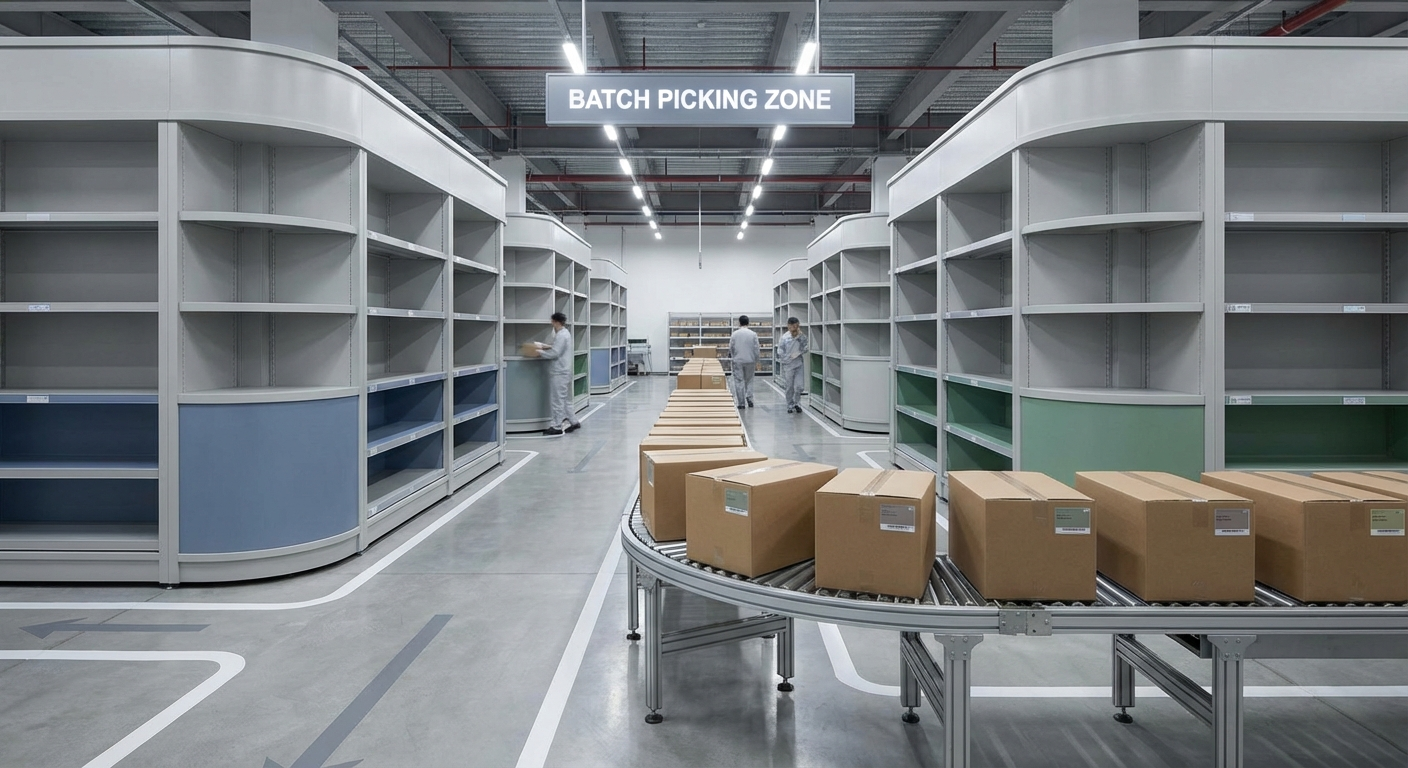
- Batch picks by sales channel and ship method to minimize handling and errors (e.g., DTC 2-day shipping batch; Amazon FBM same-day batch; Wholesale EDI batch).
- Use zone or cluster picking for multi-line, multi-SKU orders enabling operators to complete multiple picks in a single trip.
- Pre-stage fast-moving SKUs and assembled kits near packing stations.
- Follow cartonization rules and label cartons for wholesale or EDI shipments.
4) Custom kitting and assembly
- Build kits for bundles, subscription boxes, and promotions. Track lot numbers if required.
- Manage Bill of Materials (BOM) and kit revisions directly in the WMS—avoid off-system assembly.
- Pre-build recurring kits ahead of high volume periods, and use build-to-order for less frequent kits.
Related service: https://www.allpointsatl.com/services/custom-kitting-product-assembly
5) Packing per channel rules and inserts
- Include channel-specific packing slips, gift notes, and inserts; generic collateral slows operations and weakens brand experience.
- Maintain brand packaging standards, like tissue paper, branded shippers, and void fill without losing throughput.
- Apply carrier-compliant labels and required stickers (e.g., suffocation warnings) by channel.
- Use on-demand printing for inserts and marketing materials to avoid obsolete collateral and reduce waste. Related service: https://www.allpointsatl.com/services/printing-marketing-materials
6) Quality control and audit
- Perform scan-to-verify pick lines with hard stops if barcodes don’t match expected SKUs.
- Verify dimensions and weight at packing to ensure appropriate shipping methods and costs.
- Audit pick and pack batches regularly and retrain operators as needed.
- Close orders in the WMS; automatically push tracking data to all sales channels.
7) Shipping and reporting
- Rate shop carriers within your service matrix to balance cost and reliability; avoid choosing the cheapest blindly.
- Meet daily cutoff times accurately; missing cutoffs causes costly re-picks and rating penalties.
- Reconcile manifests and inventory deltas daily; update ATP in all sales channels within minutes rather than hours.
For operational insights on maintaining clear order flow patterns:
- https://www.monsooninc.com/what-makes-or-breaks-your-order-flow-in-a-multi-channel-world/
- https://crazyvendor.io/blog/multichannel-inventory-sync/

Key SLA/KPI targets for multichannel fulfillment
Without consistent KPI tracking and SLA enforcement, your multichannel operation will drift into costly errors and delays. Aim for these realistic, operator-proven targets:
KPI: Pick accuracy | Target: >99.5% | Why it matters: Every mispick leads to returns, support tickets, and negative reviews.
KPI: Dock-to-stock time | Target: <24 hours | Why it matters: Keeps inventory available for sale across channels.
KPI: Order cycle time | Target: 24–48 hours standard; same day for priority channels | Why it matters: Protects marketplace ratings and customer satisfaction.
KPI: On-time shipment rate | Target: ≥98% | Why it matters: Avoids fees, chargebacks, and channel suspension risks.
KPI: Inventory sync latency | Target: <5 minutes | Why it matters: Prevents overselling, especially during promotions and peak demand.
A common operational insight: batching picks by channel and ship method reduces touches and errors, while manual inventory syncs spike risk as the “inventory truth” shifts mid-pick cycle. Best practice is API or EDI integration with batch locks on pick release.
Pricing drivers for multichannel fulfillment
Multichannel fulfillment pricing isn’t a single number—it’s a composite of variables that affect labor, software, storage, and complexity:
- SKU count and complexity: More SKUs means more storage locations, longer pick routes, and higher error risk—especially with variants lacking clean barcodes.
- Order profile: Single-line orders move quickly. Multi-line, multi-SKU or customized orders (kits, bundles) require more labor and quality control.
- Number of sales channels and integration method: More channels add complexity with unique order flows, rules, and compliance. APIs usually cost less to implement than legacy EDI but vary with scale.
- Custom kitting and printing volume: Bundled kits with version-controlled BOMs and frequent printing of inserts add labor and material costs. Having kitting and printing under one roof reduces costly handoffs.
- Storage and slotting: Pallet storage costs more than shelving or bins. SKU sprawl inflates bin counts and slow picks. Velocity-based slotting reduces footprint and labor.
- Special packaging and handling: Fragile items, hazardous materials, branded shippers, cold packs, or custom packing add both materials and labor.
- Seasonal labor and volume surges: Peak periods require overtime, temp labor, and accelerated training. Prebuilt kits and staged inventory cut labor spikes.
- Software and WMS overhead: Real-time syncing, SKU mapping, and reporting require licenses and ongoing admin. Cheap systems often cost more via manual workarounds.
Bottom line: more complexity means more labor and system overhead. A disciplined operation with optimized SKUs, stable integrations, and clean barcodes pays less per order than a messy one, even with equal volume.

Risks and mitigations in multichannel fulfillment
Multichannel failures rarely come from volume alone—they come from sloppiness or lack of controls. These are the main risks and ways to keep them in check:
Inventory fragmentation. Risk: Stock spread across multiple systems or physical locations leads to overselling and dead stock. Mitigation: Centralize inventory in one WMS, push accurate ATP to channels, and enforce frequent cycle counting by SKU velocity.
Data silos and manual reconciliation. Risk: Manual CSV uploads or spreadsheets quickly become outdated, causing oversells during promotions or peak demand. Mitigation: Use API/EDI integrations with locked cutover windows; monitor sync latency proactively.
SKU sprawl and poor barcoding. Risk: Near-duplicate SKUs and illegible barcodes slow picking and increase mispicks. Mitigation: Rationalize the catalog, maintain one scannable barcode per SKU, freeze renaming during peak seasons.
Labor challenges during volume surges. Risk: Untrained temps and inefficient pick paths reduce throughput and increase errors. Mitigation: Pre-build kits, pre-stage high-volume SKUs, simplify packouts, and train operators on scan-to-verify SOPs.
Channel compliance and chargebacks. Risk: Missed cutoffs, incorrect labeling, or package errors trigger penalties and damage relationships. Mitigation: Maintain channel-specific SOPs, packing checklists, batch audits, and automate labels and slips through your WMS.
Returns and reverse logistics. Risk: Accumulated returns backlog degrades inventory accuracy and fulfillment rates. Mitigation: Process returns daily, apply reason codes, quarantine and rework returned stock promptly, update ATP immediately.
Avoid siloed operations across channels, which increase overhead and confusion. Use tight SOPs combined with a disciplined 3PL partner mentality enabling proactive issue detection and resolution.
The Atlanta advantage in multichannel fulfillment
Location matters hugely for ecommerce fulfillment efficiency, cost, and speed—and Atlanta offers a standout strategic advantage:
- Access to roughly 80% of U.S. parcel destinations within two days from a single facility, spanning Zones 2 through 5 efficiently.
- Dense carrier network with competitive linehaul rates leading to lower shipping costs and better on-time performance compared to coastal hubs saturated with traffic and delays.
- Same-day shipping cutoffs that still deliver quickly to most customers east of the Mississippi, plus competitive transit times to Texas and the Midwest.
- Close proximity to southeastern ports and an extensive interstate highway system optimizes inbound freight and wholesale replenishment.
- Local, hands-on implementation and support teams are critical for complex SKU mapping, kitting, printing, and integrations—avoiding endless remote troubleshooting.
Related service: https://www.allpointsatl.com/services/warehousing-distribution
What you get with All Points
- Integrated kitting, assembly, and printing services under one roof simplify complex packouts and reduce touches:
- Custom kitting and assembly: https://www.allpointsatl.com/services/custom-kitting-product-assembly
- Printing and marketing materials: https://www.allpointsatl.com/services/printing-marketing-materials
- Proven SLA/KPI discipline: dock-to-stock under 24 hours, pick accuracy above 99.5%, on-time shipping over 98%, and rigorous cycle counting.
- Atlanta-based facility with two-day reach to approximately 80% of U.S. customers, built for same-day cutoff and responsive order velocity.
- An operator-level partnership approach: we scale workflows without adding chaos, helping fix upstream SKU mapping, barcode hygiene, and insert issues alongside fulfillment.
To dig deeper into streamlined day-to-day pick and pack workflows: https://www.allpointsatl.com/services/e-commerce-order-fulfillment
Primary CTA
Get a kitting quote: https://www.allpointsatl.com/services/custom-kitting-product-assembly
Secondary CTA
Download the 3PL Guide
Sidebar note
Based in Atlanta since 1995 | Phone | Email
FAQ
1) What factors impact multichannel fulfillment pricing?
Pricing depends on SKU count and order complexity, number of sales channels and integration types (API vs. EDI), kitting and printing volume, storage footprint and types, special handling needs, seasonal surges, and WMS/admin overhead. More complexity means more touches and higher costs.
2) How do SLAs affect order accuracy across channels?
SLAs set your speed and error tolerance standards. Achieving pick accuracy above 99.5%, dock-to-stock under 24 hours, and inventory syncs within 5 minutes prevents oversells. On-time shipment rates above 98% maintain marketplace ratings and avoid chargebacks.
3) What is the typical order cycle time with multichannel fulfillment?
Standard order cycle time is 24 to 48 hours from order receipt to carrier scan. Priority channels like Amazon FBM or Seller Fulfilled Prime often require same-day shipping. Wholesale and EDI cycles depend on routing guides and carrier pickups.
4) How can a 3PL help prevent inventory silos with multiple sales channels?
By making your WMS the single source of truth integrated via API/EDI, enforcing disciplined cycle counts, and pushing real-time ATP updates to all channels. This replaces manual reconciliation and siloed spreadsheets with robust, automated inventory synchronization.
5) Why is Atlanta a strategic location for ecommerce fulfillment?
Atlanta enables two-day delivery to about 80% of U.S. customers from one facility, keeping average shipping zones low. It benefits from a consistent and competitive carrier network, reducing shipping costs while protecting delivery speed and marketplace ratings.
Bad ideas to avoid (from experience)
- Managing Amazon FBM and DTC inventory in separate systems—these will disagree at peak times causing oversells.
- Building kits at packing stations without BOMs maintained in the WMS, leading to inventory shortfalls and erroneous orders.
- Receiving shipments without scannable barcodes, which doubles dock-to-stock time and causes cycle count errors.
- Rebranding SKUs or renaming barcodes during Q4 peak seasons; keep names and codes stable to avoid label confusion and errors.
How to start clean
- Standardize barcodes and rationalize SKUs beforehand. Freeze naming changes during peak periods.
- Define safety stock, allocation, and channel-specific packout rules upfront.
- Fully integrate all sales channels with your WMS and perform complete end-to-end integration testing, including returns and reverse logistics.
- Run a parallel operation for at least one week with rigid audits before going fully live in multichannel fulfillment.
About All Points
All Points is an Atlanta-based, family-owned third-party logistics (3PL) provider founded in 1995. We deliver end-to-end logistics services: custom kitting, ecommerce fulfillment, warehousing, distribution, and printing—helping your brand ship accurately, on time, and at scale.
Disclaimer
All operational insights and data presented reflect industry standards and All Points’ proprietary expertise at the time of writing. Results may vary based on individual business circumstances and WMS/platform configurations. This article is for informational purposes and does not constitute a guarantee of performance.
Thank you for considering All Points as your multichannel fulfillment partner.
Conclusion
Multichannel fulfillment streamlines orders across channels by centralizing inventory, syncing systems, and enforcing strict SLAs to prevent errors and oversells. Learn workflows, pricing drivers, risk mitigation, and why Atlanta’s strategic location boosts speed and cost-efficiency for seamless ecommerce growth.

.webp)
.webp)
.webp)
.webp)


