


Ecommerce Fulfillment: How to Scale Operations Without Sacrificing Accuracy
Ecommerce fulfillment gets complicated fast, especially once you exceed a few hundred orders daily. If you’re a founder, ops lead, or procurement manager comparing third-party logistics providers (3PLs), this guide explains real workflows, pricing drivers, SLAs, and risks so you can request a realistic quote, set expectations, and ship accurately at scale.

What is Ecommerce Fulfillment and When to Use It?
Ecommerce fulfillment is the operational core behind your “Buy Now” button and customer experience. It consists of:
• Receiving inventory, putting it away securely, and tracking it with discipline
• Picking and packing orders accurately every time
• Kitting or light assembly to create saleable, custom bundled units
• Carrier selection, labeling, and outbound shipping
• Returns processing and inventory reconciliation
Fulfillment is more than just shipping boxes; it is an end-to-end process ensuring your customers get the right product, in pristine condition, as fast as promised.
When Should Brands Outsource to a 3PL?
Consider partnering with a third-party fulfillment provider when:
• Your order volume regularly exceeds approximately 200–300 daily transactions, straining in-house labor capacity
• Your SKU count grows, introducing lookalike items, multi-pack outs, or complex bundles
• You begin selling across multiple marketplaces or add wholesale EDI alongside your direct-to-consumer (DTC) sales channels
• Your internal team struggles to meet increasingly tighter SLAs (service-level agreements)
• You want to consolidate kitting and ecommerce fulfillment under one roof to reduce handoffs and errors, improving accuracy
Many brands start handling fulfillment themselves when product catalogs and sales are small and simple. However, as order velocity spikes or SKU complexity grows, warehouse discipline—not just physical space—becomes the critical limitation. Without rigorous processes, error rates increase and costs escalate. Ultimately, brands outgrow in-house fulfillment before realizing the hidden inefficiencies that push up cost per order and damage customer experience.
To learn more about common fulfillment challenges that ecommerce startups face: https://itbfulfillment.com/insights/7-common-fulfillment-challenges-for-ecommerce-startups-and-how-to-solve-them/

Step-by-Step Ecommerce Fulfillment Workflow
Successful ecommerce fulfillment operates on disciplined, repeatable workflows that balance speed and accuracy. Here is an operator-level step-by-step guide to how All Points runs ecommerce fulfillment daily:
• Order Receipt and Validation: Orders flow in via ecommerce platform APIs, order management systems (OMS), or electronic data interchange (EDI) using standards such as 940 (warehouse shipping order) and 945 (warehouse shipping advice). We validate shipping addresses, SKU availability, and order holds before releasing them. Orders are systematically routed by service level, sales channel, and packaging specifications.
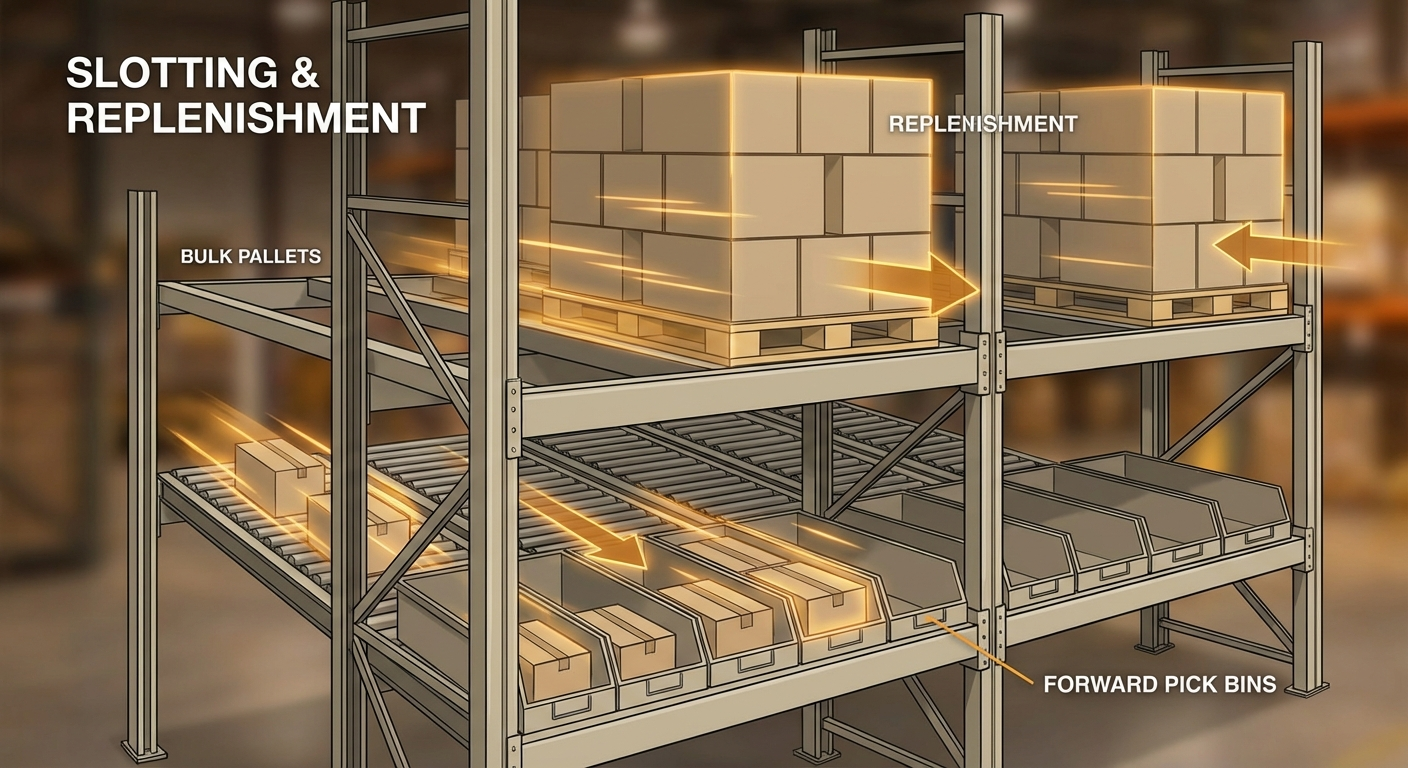
• Wave Planning and Batch Picking: Similar orders are grouped to minimize picker travel time—orders with the same SKUs, shipping zones, or packaging classes are batched together. High-velocity SKUs get dedicated pick lanes and forward pick bins to reduce steps and touches.
• Replenishment and Slotting: Forward pick locations are replenished from bulk storage based on minimum/maximum inventory thresholds and demand forecasts. Lookalike SKUs and high-risk items are clearly labeled and stored separately to maintain pick accuracy.
• Picking: Pick methods vary by SKU density and order mix—single order picking, batch picking, or cluster picking by zone. Barcode scanning is mandatory, enforcing “no scan, no pick.” Exceptions such as out-of-stock conditions, substitutions, and quality flags are handled in real time with system alerts.
• Packing and Quality Control: At packing stations, SKUs and quantities are scanned and weighed to expected profiles. Inserts, promotional materials, and branding elements are applied here. Custom kitting and printed materials are also added in the packing step to maintain clean throughput. Keeping kitting and packing under one roof reduces handoffs and errors. Learn more: https://www.allpointsatl.com/services/custom-kitting-product-assembly
• Labeling and Carrier Selection: Shipping labels are created by rules weighing SLA, zone, weight, dimensional data, hazmat classification, and cost optimization. We manifest with scheduled carrier dock appointments and trailer staging to meet daily cutoffs.
• Inbound and Dock-to-Stock Receiving: Receiving is scheduled and driven by advance ship notices (ASNs) and packing lists for variance checks. We count, inspect, label if needed, and quickly move inventory to forward pick or reserve locations. A clean receiving process prevents delays downstream.
• Load Balancing and Shipping Cutoffs: Staffing and equipment are planned based on order velocity forecasts. During promotional spikes, orders may be re-waved and overflow packing lanes opened. Firm daily cutoffs guarantee the highest on-time ship percentages with carrier pickups.
What Actually Lowers Error Rates and Raises Throughput?
• Enforcing barcode scanning and standard operating procedures (SOPs) eliminates informal “tribal knowledge” and guesswork
• Strategic slotting and visual management for lookalike SKUs reduces mis-picks
• Daily communication cadence between your team and ours ensures we’re aligned on forecasts, promos, and exceptions
• Batching similar orders minimizes redundant picks of the same SKU in different orders
• Strict cutoffs and well-staffed docks avoid wasted picks caused by late carrier departures
Additional references: https://www.radial.com/insights/top-7-ecommerce-fulfillment-challenges-and-how-to-overcome-them and https://www.inboundlogistics.com/articles/ecommerce-fulfillment-7-pitfalls-to-avoid/
Ecommerce Fulfillment SLAs and KPIs You Should Hold Your 3PL To
Metric: Pick Accuracy | Industry Standard: 99.5%+ | All Points Target: 99.8%+ | How We Achieve It: Forced scanning, SKU separation, SOP audits
Metric: On-time Ship | Industry Standard: 98%+ | All Points Target: 99%+ | How We Achieve It: Firm cutoffs, re-waving, pre-staged pickups
Metric: Order Cycle Time | Industry Standard: <24 hours | All Points Target: ~12 hours average | How We Achieve It: Multiple daily waves, overflow lanes, cross-training
Metric: Dock-to-Stock | Industry Standard: 4–8 hours | All Points Target: 2–6 hours | How We Achieve It: Scheduled receiving, dedicated lanes, ASN checks
Metric: Inventory Accuracy | Industry Standard: 97–99% | All Points Target: 99%+ cycle-counted | How We Achieve It: ABC cycle counts, tight reconciliation, vendor scorecards
If your 3PL can’t provide these numbers weekly, their operation may be unproven or unreliable.

Pricing Drivers in Ecommerce Fulfillment
Understanding what drives ecommerce fulfillment costs helps you evaluate quotes better and identify unnecessary expenses. Here are the main price levers:
• Labor Intensity: Simple single-line, single-unit orders require minimal labor. Complex, multi-line, fragile, or regulated SKUs demand more handling time and care. Lookalike SKUs increase mis-pick risk, mitigated by slotting, labeling, and scanning, which adds labor time.
• Kitting and Value-Add Services: Pre-building kits or subscriptions reduces labor on high-volume shipping days, stabilizing throughput and lowering peak costs. Combining kitting and packing under one roof (instead of outsourcing to separate vendors) avoids rehandling, repalletizing, and reduces damage risks. Details: https://www.allpointsatl.com/services/custom-kitting-product-assembly
• Packaging Materials: Custom boxes, printed tissue, inserts, and branded packaging enhance customer experience but increase pack station time. Right-sizing packaging reduces dimensional (DIM) weight charges and minimizes damage. We partner with you to engineer optimized packaging solutions.
• Storage and Inventory Profile: Velocity-based slotting with bulk inventory on pallets and fast movers in forward pick bins reduces unnecessary labor. Slow movers in forward picks cause idle inventory costs and inefficiency.
• Technology and Integrations: Ecommerce platform connectors usually integrate quickly, but EDI for retail/wholesale (e.g., 940/945 for advanced ship notices, 850/856 for purchase orders and shipments) requires dedicated setup, testing, and compliance monitoring. There’s a setup cost plus a small per-order fee. Plan accordingly.
• Freight Costs: Shipping is the largest expense. Carrier zone and service-level decisions significantly impact margins. Atlanta’s central location reduces zones for approximately 80% of U.S. orders, offering tangible freight savings.
Costs That Shouldn’t Exist but Do
• Duplicate SKUs for the same physical item that cause picking confusion
• Case packs that don’t align well with order demand (e.g., 7-packs increasing excess inventory)
• Missing, damaged, or non-standard barcodes that complicate scanning and raise errors
• Over-customized packouts adding complexity without boosting revenues or reducing returns
Cleaning up SKU logic and packaging before engaging a 3PL pays off. No 3PL can fully compensate for undisciplined inputs without inflating costs.
Additional references: https://3plcenter.com/fulfillment-mistakes/ and https://www.staciamericas.com/blog/top-5-ecommerce-fulfillment-pain-points-and-their-solutions

Risks and How All Points Mitigates Them
Common risks in ecommerce fulfillment and how All Points addresses them:
• Mis-picks Caused by SKU Sprawl or Poor WMS Discipline: Mitigation: Mandatory barcode scanning, GS1 barcode standards compliance, lookalike SKU risk tagging, logical slotting, and pack station weight checks.
• Volume Spikes and Missed Cutoffs: Mitigation: Rolling 4–6 week volume forecasts, daily operational huddles, cross-trained labor pool, overflow packing lanes, and pre-built batches for promotions and subscriptions.
• Damage During Kitting or Packing: Mitigation: Engineered packaging, right-sized boxing, dunnage standards, and in-house durability testing. Learn more: https://www.allpointsatl.com/services/custom-kitting-product-assembly and https://www.allpointsatl.com/services/printing-marketing-materials
• Inventory Inaccuracies Delaying Fulfillment: Mitigation: ABC cycle counting, inbound variance checks, supplier scorecards, and tight reconciliation protocols. Variances are quarantined and never shipped blindly.
• Integration Failures and Order Holds: Mitigation: Monitored EDI/API connections with alerting, retry logic, and manual release protocols prevent bad data from flowing downstream.
• Returns Pileups: Mitigation: Dedicated returns (RMA) lanes with barcode intake, grading rules, and near-real-time restock of saleable returned goods.
Most surprises are preventable with consistent SOP enforcement and capacity planning. Automation helps, but discipline scales accuracy.
The Atlanta Ecommerce Fulfillment Advantage
All Points’ Atlanta location offers a strategic logistics advantage:
• 2-Day Ground Reach to ~80% of U.S. Addresses: This reduces shipping zones, cuts freight expenses, and enables brands to promise fast delivery without costly air shipments.
• Central Access to I-75/I-85 Corridors and Hartsfield-Jackson Atlanta International Airport: With easy highway access and the world’s busiest airport nearby, inbound replenishments and exception handling are fast and reliable.
• Earlier Deliveries and Later Cutoffs Than Coastal Networks: You get more operational leeway, speeding up order processing and reducing rush shipping premiums.
If your orders ship nationally and aren’t just coastal, Atlanta offers clear logistical and financial advantages. Learn more: https://www.allpointsatl.com/services/e-commerce-order-fulfillment
What You Get with All Points
• End-to-End Ecommerce Fulfillment Under One Roof: Picking, packing, kitting, printing, and distribution with fewer handoffs and lower error rates. Learn more: https://www.allpointsatl.com/services/e-commerce-order-fulfillment
• Operator-Grade SLAs and Transparent Reporting: Weekly KPI reports with root-cause analysis and rapid issue resolution. No excuses, just results.
• Custom Workflows Built Around Your SKU Catalog: Tailored slotting, batching, and packout designs based on SKU velocity and order mix. Subscription schedules enable precise daily cutoffs.
• Kitting Plus Printing Services Without the Runaround: For example, we helped a premium automotive brand streamline printed components and kitted sets in one facility, reducing touches and scrap while improving quality control. Learn more: https://www.allpointsatl.com/services/printing-marketing-materials
• An Atlanta-Based Team That Scales With You: Family-owned since 1995, we have grown with brands from 100 to 1,000+ daily orders without sacrificing accuracy or service quality.
Primary CTA
Get a kitting quote: https://www.allpointsatl.com/services/custom-kitting-product-assembly
Secondary CTA
Download the 3PL Guide: [Insert lead magnet link]
FAQ
What does ecommerce fulfillment include? Ecommerce fulfillment encompasses receiving inventory, putaway, inventory control, order picking, packing, kitting or assembly where needed, carrier labeling and shipping, returns processing, and reporting. We also handle printing and packaging development when it reduces cost and damage risk.
How long does implementation take?
• Simple DTC cart integration with standard packouts: 1–3 weeks
• Mixed DTC and wholesale with EDI (940/945, 850/856), complex packouts, or subscription kitting: 3–6 weeks depending on testing and data readiness
• The longest phase often involves cleaning SKUs, barcodes, and pack specification alignment
What KPIs should I expect from my 3PL?
• Pick accuracy: 99.5%+
• On-time ship: 98–99%+ for orders released before cutoff
• Order cycle time: Under 24 hours
• Dock-to-stock: Under 8 hours for standard receipts
• Inventory accuracy: 99%+ maintained by cycle counting
How does All Points handle volume spikes? By forecasting staffing and labor needs 4–6 weeks ahead, maintaining cross-trained labor, opening overflow pack lanes, and re-waving orders during the day. For promotions and subscription products, we pre-build kits and stage materials to maintain daily cutoffs.
What are typical ecommerce fulfillment pricing drivers? Key drivers include touches per order (lines, fragility, special handling), packaging materials, storage profile (pallets vs bins), technology integration costs, and freight expenses. Poor SKU hygiene and over-customized packouts add costs without benefits and should be addressed prior to engaging a 3PL.
Ecommerce fulfillment isn’t about finding the cheapest picker. It’s about disciplined workflows, reliable and measurable SLAs, and having a 3PL partner who can absorb complexity without sacrificing accuracy. If you’re hitting growth ceilings or noticing rising error rates, it’s time to tighten data hygiene, fix SKU logic, and partner with a 3PL that operates as an extension of your team.
All Points is an Atlanta-based, family-owned 3PL founded in 1995. We deliver end-to-end logistics—from custom kitting and ecommerce fulfillment to warehousing, distribution, and printing—so your brand ships accurately, on time, and at scale.
Helpful Links
Custom kitting & product assembly: https://www.allpointsatl.com/services/custom-kitting-product-assembly
Ecommerce order fulfillment: https://www.allpointsatl.com/services/e-commerce-order-fulfillment
Printing & marketing materials: https://www.allpointsatl.com/services/printing-marketing-materials
Warehousing & distribution: https://www.allpointsatl.com/services/warehousing-distribution
Disclaimer: This article is for informational purposes only and does not constitute legal or financial advice. All Points makes no warranties regarding the completeness or accuracy of content and recommends consultation with appropriate professionals for specific operational decisions.
Sidebar Contact Module
Based in Atlanta since 1995 | Call: XXX-XXX-XXXX | Email: contact@allpoints.com
Sources Consulted for Additional Insights on Ecommerce Fulfillment Challenges & Solutions
ITB Fulfillment: https://itbfulfillment.com/insights/7-common-fulfillment-challenges-for-ecommerce-startups-and-how-to-solve-them/
3PL Center: https://3plcenter.com/fulfillment-mistakes/
Radial: https://www.radial.com/insights/top-7-ecommerce-fulfillment-challenges-and-how-to-overcome-them
Inbound Logistics: https://www.inboundlogistics.com/articles/ecommerce-fulfillment-7-pitfalls-to-avoid/
Staci Americas: https://www.staciamericas.com/blog/top-5-ecommerce-fulfillment-pain-points-and-their-solutions
Please contact us for more information or a personalized fulfillment analysis.
Conclusion
Scaling ecommerce fulfillment requires disciplined workflows, accurate inventory management, and reliable SLAs. This guide reveals how to optimize operations, choose the right 3PL, control costs, and mitigate risks—ensuring your brand ships faster and error-free as order volumes grow. Partner smart to scale confidently.

.webp)
.webp)
.webp)
.webp)


