


Understanding Shopify Shipping Profiles: How They Impact Order Fulfillment & Delivery Speed
Shopify shipping profiles let you set processing times for different products—key for direct-to-consumer brands managing shipping expectations and fulfillment workflows. This post breaks down how these profiles work, how they impact your logistics SLAs, pricing, and risks, plus why Atlanta-based fulfillment can speed up delivery for your customers.
What Are Shopify Shipping Profiles, and When Should You Use Them?
Shopify shipping profiles are powerful tools that enable merchants to assign product-specific handling times and shipping rates. With Shopify shipping profiles, you can group products with similar shipping origins, rates, and processing requirements into a unique set of rules applied during checkout and fulfillment. This allows you to customize shipping experiences based on product type, location, or handling complexity.
When should you use Shopify shipping profiles? They are especially beneficial for businesses with:
- Complex SKUs: Products with varying handling or processing time, such as made-to-order items, bundles, or subscription boxes.
- Mixed product types: Combining stocked inventory with custom or kitted products.
- Subscription box models: Where assembly and packaging times differ markedly from regular orders.
- Special handling needs: Hazardous, oversized, or temperature-sensitive products requiring different carriers or service levels.
- Multi-origin shipping: Managing orders fulfilled from warehouses, dropshippers, or factories.
Why does this matter? Shopify shipping profiles directly impact order processing timing, shipping promises made at checkout, and ultimately the customer experience. They help align logistics workflows with what customers see, minimizing surprises and improving on-time delivery performance.
For more on Shopify’s processing time concepts, see Shopify’s official guide.
Shopify Shipping Profiles Workflow: Step-by-Step Fulfillment Process
To optimize how Shopify shipping profiles impact your order fulfillment, understanding the typical operational workflow is key. Here’s how order processing aligns with profiles:
- Order Intake and Mapping
Each line item in the order is assigned to a Shopify shipping profile based on SKU configurations. The warehouse management system (WMS) imports the order and applies profile-specific routing rules—such as prioritizing fast-ship or kitting-required labels. When mix-and-match orders arise, split shipments are flagged if your policy supports sending items separately to meet respective SLAs. - Inventory Validation
Real-time inventory checks occur per warehouse location to validate available stock. If items are backordered or preordered, their promised processing time is updated, and customers receive notifications about changes. - Batching and Picking Orders
Orders are batched by profile and processing timeline: fast-ship waves go first, followed by slower, more complex batches. Pick paths are optimized to reduce travel time, and kit-required SKUs are picked separately to avoid blocking simpler picks. - Kitting and Assembly
For profiles involving kitting or assembly, warehouse staff follow bills of materials (BOMs) and standard operating procedures (SOPs). In-process quality control includes counts, label accuracy, and insert verification. Completed kits are staged either pre-kitted or married directly to orders, depending on your workflow. - Packing and Shipping
Orders adhere to daily cutoff times based on profile SLAs. Carriers and service levels are auto-selected to meet promised delivery windows, considering restrictions like ORM-D or hazardous materials. Shipping labels and marketing inserts are finalized before manifest closure. - Status Updates and Exceptions
Tracking information is pushed to Shopify immediately after shipping. If an order is held due to a slow-processing item and split shipments aren’t allowed, customers receive notifications or alternatives are offered. Escalations occur daily for orders nearing SLA breach.
This workflow ensures that Shopify shipping profiles don’t just exist as settings but actively drive fulfillment operational excellence.

Shopify Shipping Profiles SLAs & KPIs
Effective management requires explicit service-level agreements (SLAs) and key performance indicators (KPIs) tuned to each profile's requirements—especially because processing times vary across profiles. The table below shows example SLA targets:
| Metric | Target Value | Notes |
|---|---|---|
| Pick accuracy | ≥ 99.8% | Mixed SKUs and kitting components demand scanning discipline to minimize errors. |
| Order cycle time | Profile-dependent* | Fast profiles often same-day; slow/kit profiles may need 1-2 business days. |
| Dock-to-stock | ≤ 12 hours | Inventory accuracy is critical to maintain profile assignments and SLAs. |
| On-time ship rate | ≥ 98% | Orders should adhere strictly to processing times communicated to customers. |
| Backorder rate | ≤ 1% of order lines | High backorder rates suggest issues in forecasting or inventory management. |
| Cutoff adherence | ≥ 95% | Ensures orders placed before cutoff ship same-day on fast profiles. |
*Profiles with longer processing times require adjusted order cycle targets. Communicate these clearly on Shopify at checkout to manage customer expectations.
Maintaining these targets consistently is essential to reduce delays and uphold customer trust.

Pricing Drivers for Shopify Shipping Profile Fulfillment
Multiple shipping profiles increase complexity and, consequently, fulfillment costs. Key pricing drivers include:
- Profile Complexity: More profiles necessitate additional routing logic and exception handling in your WMS, driving up configuration and labor overhead.
- SKU Sprawl: Profiles with many SKUs broaden picking routes and add touches, which lengthen pick times and increase error risk.
- Kitting and Assembly Labor: Profiles requiring assembly mean extra manpower, BOM management, quality checks, and staging time that directly raise labor costs.
- Processing Time Buffers: Longer processing times translate into stored WIP inventory, consuming space and increasing storage costs.
- Volume Variations by Profile: Peaks in slow-profile orders demand surge staffing or risk SLA failures.
- Split Shipments: Enabling split shipments to protect delivery speed increases parcel spend and packing labor.
Understanding these drivers helps set realistic pricing models for Shopify profile-based fulfillment.

Risks & Mitigations When Using Shopify Shipping Profiles
Shopify shipping profiles simplify many complexities but bring risks if mismanaged. Here are common failure modes and mitigation strategies:
- Misaligned Processing Times and Capacity
Risk: Promising 1–2 days on custom orders but routinely taking 3–4 days during peak demand.
Mitigation: Tighten SOPs, increase pre-kitting where possible, set honest processing times aligned with actual capacity, and implement daily WIP caps. - Mixed Cart Delays
Risk: Fast SKUs delayed because customers mix them with slow-processing items.
Mitigation: Allow split shipments or re-architect SKUs so custom components ship separately as add-ons. - Complex Profile Logic Inside WMS
Risk: Profiles don’t translate neatly into warehouse workflows, causing batching failures and missed cutoffs.
Mitigation: Mirror Shopify shipping profile rules exactly within your WMS, batch by SLA and location, and lock down picking paths to reduce chaos. - Mismatch Between Rate Cards and Operational Reality
Risk: Charging ground shipping but needing expedited services to meet promised delivery times.
Mitigation: Rebuild zone- and cutoff-based rate logic. Adjust shipping options or extend processing times as needed. - Inventory Inaccuracies
Risk: Shopify shows in-stock while pick faces do not, resulting in order holds.
Mitigation: Aim for dock-to-stock cycles under 12 hours, conduct regular cycle counts for high-velocity SKUs, and automate replenishments for kit components. - Manual Overrides
Risk: Staff manually override SLAs to push orders through, creating inconsistencies downstream.
Mitigation: Restrict override permissions, maintain audit trails, and use daily SLA performance dashboards.
Proactive governance of these risks stabilizes your fulfillment flow and reinforces delivery promises made via Shopify.

Atlanta Advantage: Faster Fulfillment with Shopify Shipping Profiles
The physical location of your fulfillment partner can dramatically influence how Shopify shipping profiles affect delivery speed. Atlanta offers a strategic advantage:
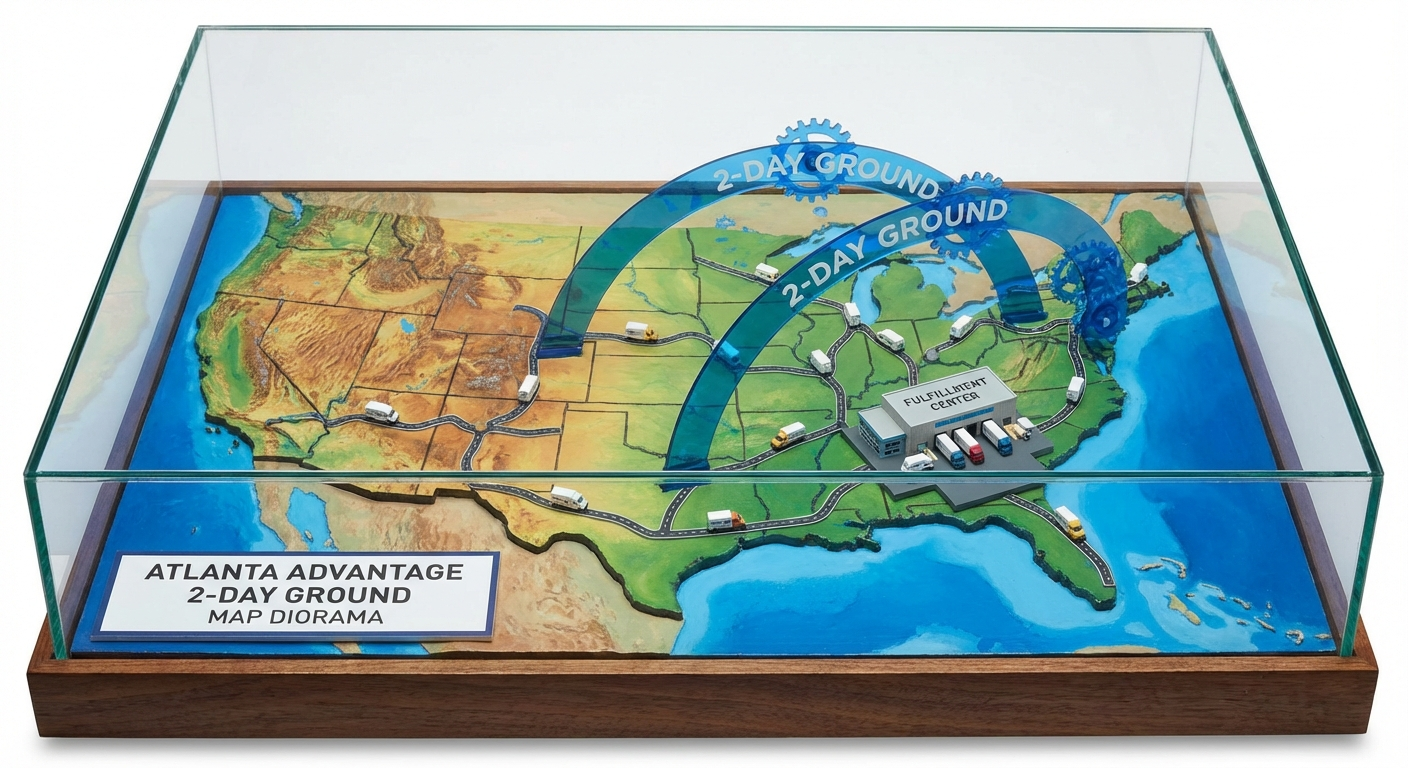
- Atlanta’s 3PL hubs provide 2-day ground delivery to approximately 80% of U.S. customers, helping brands rely on cost-effective ground services even with varied profile processing times.
- Faster transit compensates for longer processing windows common in complex profiles like kitting or assembly.
- Centralized warehousing with integrated kitting, printing, and fulfillment reduces handoffs, shrinks WIP inventory, and tightens order cycle time variability.
- This geographic advantage means orders on both “fast” and “slow” profiles typically ship quicker to final customers than national averages.
Leveraging Atlanta-based fulfillment can therefore accelerate delivery despite Shopify shipping profile complexities.
What You Get with All Points
Our services are calibrated to support Shopify shipping profiles with precision and transparency:
- Custom kitting and assembly tailored to Shopify shipping profiles: Streamline complex product bundles and kits with exact processing time alignment. Learn more
- Ecommerce order fulfillment tuned to profile processing times: Maintain on-time shipping and efficient batching across all profiles. Learn more
- Warehousing focused on inventory accuracy to support profile SLAs: Rapid dock-to-stock cycles and cycle counting reduce stock inaccuracies and boost fulfillment accuracy. Learn more
- Printing and marketing materials integrated with packout strategy: Support personalized inserts and packouts that enhance customer experience. Learn more
By tightly aligning Shopify shipping profiles with operational SOPs and WMS systems, we set expectations sensibly and meet them consistently.
Practical Configuration Tips for Shopify Shipping Profiles
To get the most from your shipping profiles, follow these practical setup tips:
- Map SKUs to profiles by actual handling time and packaging type rather than product category. For example, a candle kit needing inserts should belong to a "kitting" profile, not grouped with simple candle SKUs.
- Set processing times based on measured averages plus a reasonable buffer, e.g., if kitting averages 6–8 hours, set processing at 1 business day instead of padding 2–3 days unnecessarily.
- Publish clear cutoff times at checkout (e.g., orders placed by 2 p.m. ET ship same day for fast profiles).
- Define split-ship policies for mixed carts, allowing automatic splits when slow items add >1 business day delay, or offer customers a paid option.
- Pre-kit 80/20 bundles by pre-building the top 80% of variant combinations for faster assembly.
- Monitor SLAs weekly, and if on-time ship falls below 98%, address bottlenecks or revisit processing time assumptions.
Examples of Profiles Causing Avoidable Delays (And How We Fix Them)
- Apparel with on-demand heat transfers mixed with stocked tees:
Problem: 3-day processing times for custom transfers slow entire orders.
Fix: Stock popular sizes/colors pre-printed; treat fully custom orders in separate profiles with split-ship enabled. - Beauty subscription boxes assembled weekly sold alongside DTC items:
Problem: Subscription box orders drag DTC shipping promises to 5–7 days.
Fix: Pre-assemble subscriptions weekly and run DTC on a fast profile. Allow split shipping for combined carts or gate cutoff times. - Seasonal gift bundles with 10+ components:
Problem: Kit production stalls due to stockouts, ballooning processing time.
Fix: Freeze BOMs 30 days ahead, maintain safety stock on components, cycle count kit parts daily, and pre-kit top movers.
FAQs
How do Shopify shipping profiles impact fulfillment timelines?
Shopify shipping profiles define processing times at product or variant level combined with carrier transit times. Delivery dates reflect the slowest processing time on the order, so mixed-item carts shift promised dates later. Proper setup influences fulfillment batching and SLAs. Learn more from Shopify’s processing time documentation.
What SLAs should I set for orders with multiple profiles?
Set realistic SLAs per profile: same-day shipping for fast profiles with clear cutoffs, 1–2 business days for kitting or assembly profiles. For mixed-profile carts, either enable split shipments or communicate the longer SLA at checkout transparently.
How does All Points handle processing time variation in Shopify profiles?
We mirror Shopify shipping profiles and processing times exactly within our WMS, batch orders by SLA, and isolate kitting workflows to keep fast picks flowing uninterrupted. Our reporting tracks on-time shipping against each profile’s SLA.
What are common pricing drivers for profile-based fulfillment?
Key cost factors include profile complexity, labor for kitting and assembly, split shipments increasing parcel costs, and longer WIP/staging time consuming space and handling. SKU sprawl within profiles also inflates pick path times.
How quickly can I onboard Shopify shipping profile workflows at All Points?
Onboarding typically takes 2–4 weeks, covering profile-WMS configuration, SOP development, dock-to-stock optimization, test orders, and SLA launch. Complex kitting adds BOM validation and pilot runs.
Get a Kitting Quote Today
Align your Shopify shipping profiles with fulfillment workflows optimized for accuracy and speed. Contact All Points for a customized quote or expert consultation out of Atlanta, where we have operated since 1995.
- Request a quote: https://www.allpointsatl.com/request-free-quote/fulfillment-services
- Download our free 3PL guide: https://www.allpointsatl.com/downloads/3pl-guide
Image alt text: Workflow diagram showing Shopify shipping profiles, processing times, and 3PL batching steps.
References and Further Reading
- Shopify Shipping Speeds Overview
- How Long Does Shopify Take to Ship? | Shipaid
- Shopify Processing Time and Delivery Dates
- Shopify Fulfillment Setup
Disclaimer:
This article is for informational purposes only. While we strive for accuracy, All Points makes no guarantees regarding the outcomes of specific Shopify shipping profile configurations or fulfillment processes. Always consult with an All Points expert or your logistics provider to tailor workflows to your unique business needs.
Conclusion
Shopify shipping profiles let merchants tailor processing times and shipping rules per product, impacting fulfillment speed and customer expectations. Understanding setup, SLAs, pricing drivers, and risks—plus leveraging Atlanta-based fulfillment—helps optimize deliveries, reduce delays, and boost customer satisfaction.

.webp)
.webp)
.webp)
.webp)


