


Dead Stock Management for DTC Brands: What It Costs, How to Control It with All Points
Dead stock ties up space, capital, and complicates fulfillment workflows. This post is for DTC founders, operations managers, and retail marketers looking to understand dead stock management costs, operational steps, KPIs, and how a reliable 3PL partner can reduce its impact. Here’s a clear plan to regain inventory health and warehouse efficiency.
What is Dead Stock Management and When to Use It?
Dead stock is unsellable inventory caused by lost demand or seasonality, tying up capital and warehouse space. More than just slow-moving stock, dead stock is inventory that will not sell without deliberate intervention such as markdowns, bundling, or channel shifts.
You should prioritize dead stock management in these scenarios:
• After regular aging reports reveal stagnant SKUs no longer contributing to sales velocity.
• During SKU rationalization projects when evaluating product line profitability and bin space.
• Prior to large inventory liquidations or warehouse layout overhauls.
Operationally, dead stock management matters because it:
• Reduces excess storage costs. Dead stock occupies costly pallet or bin locations that could be used more profitably.
• Prevents picking errors. Mixing dead stock with active SKUs causes mis-picks and order returns.
• Improves dock-to-stock flow. Removing non-selling items reduces labor wasted on audits and cycle counts.
Dead stock is a hidden inventory drain that quietly erodes margins and warehouse throughput if left unchecked.

Step-by-Step Dead Stock Management Workflow
A disciplined operational approach helps brands control dead stock build-up and its related costs:
1. Conduct Regular Inventory Audits Targeting Slow-Moving SKUs. Identify candidate SKUs based on sales velocity, aging, and turnover metrics with data pulled from your warehouse management system (WMS).
2. Analyze Aging Reports and Turnover Ratios Monthly. Monitor inventory aging buckets (e.g., 0–30, 31–60, 61–90, 91–180, 180+ days) and SKU turnover to flag dead stock early.
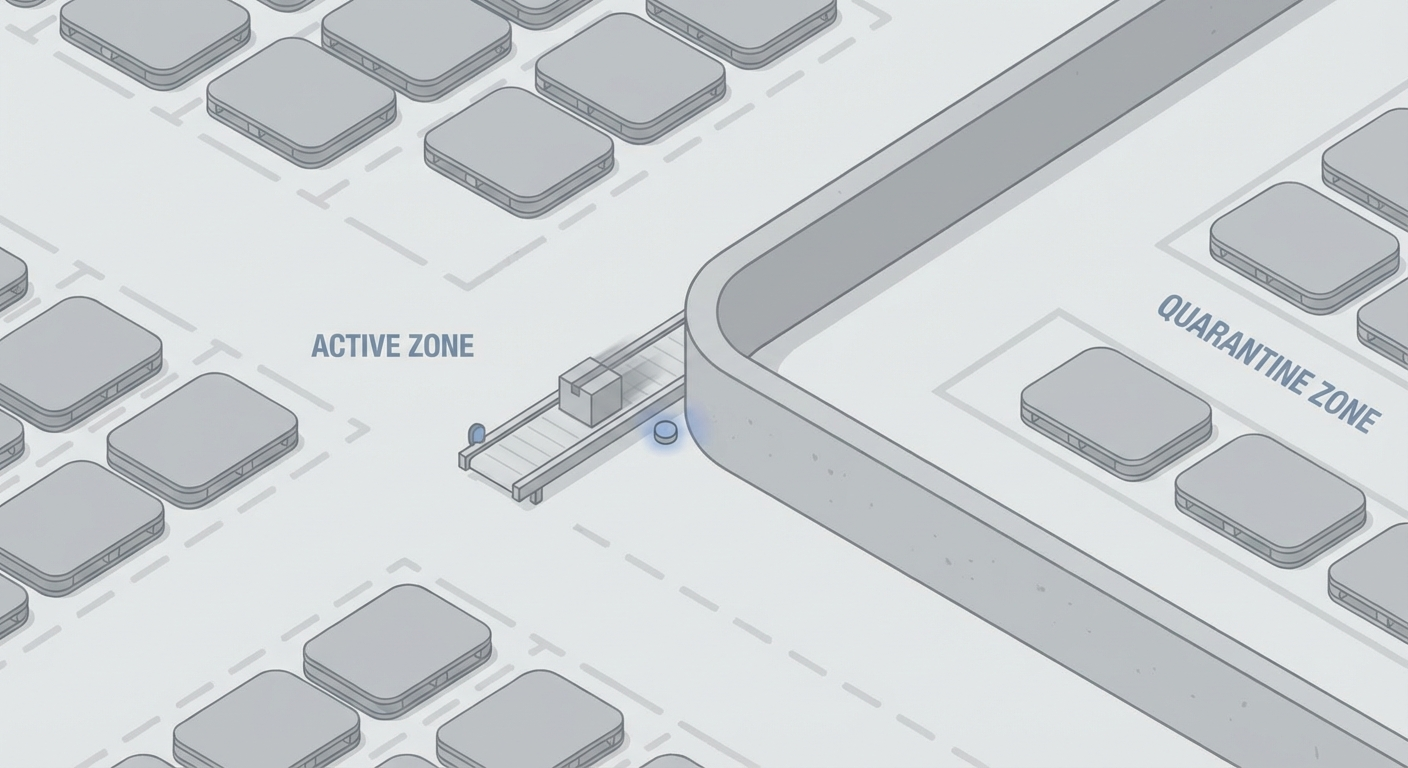
3. Segregate Tagged Dead Stock Physically in the Warehouse. Once identified, move dead stock to designated quarantine zones clearly labeled to prevent accidental picking.
4. Plan Disposition Strategies. Collaborate with procurement and marketing teams to decide whether to discount, return, recycle, donate, or bundle the dead stock.
5. Update WMS to Reflect Dead Stock Status. Modify SKU statuses with reason codes (obsolete, seasonal, RTV pending) ensuring visibility across teams and eliminating allocation errors.
6. Schedule Periodic Reviews (Typically Quarterly). Assess the efficacy of dispositions and evaluate kitting or packaging adjustments to proactively prevent future dead stock.
7. Coordinate with 3PL for Reverse Logistics and Liquidation. Leverage your 3PL’s expertise and infrastructure to handle returns, donations, or liquidation efficiently.
This workflow blends accurate data, tight operational discipline, and cross-team coordination to turn dead stock from a liability into a manageable business process.

Dead Stock KPI / SLA Table
KPI: Inventory turnover | Target / Standard: > 6 turns/year | Why It Matters: Ensures inventory is sold timely and capital is optimized
KPI: Dead stock ratio | Target / Standard: < 5% of inventory value | Why It Matters: Caps capital trapped in non-selling goods
KPI: Pick accuracy | Target / Standard: ≥ 99.8% | Why It Matters: Prevents mis-picks from inadvertently including dead stock
KPI: Dock-to-stock time | Target / Standard: < 24 hours | Why It Matters: Speeds replenishment, keeps operations flowing smoothly
KPI: On-time ship rate | Target / Standard: ≥ 98% | Why It Matters: Avoids delays potentially caused by dead stock issues
Tracking these KPIs consistently highlights problem areas, allowing for swift corrective action.

Pricing Drivers of Dead Stock Management
Dead stock management costs arise mainly from how long items occupy space and labor resources.
• Storage costs increase as dead stock occupies pallet or bin locations longer than active SKUs. Each month compounds these fees.
• Additional labor is needed for physically segregating dead stock, performing audits, and conducting detailed cycle counts.
• Reverse logistics handling fees accrue when managing returns, donations, or liquidations out of the warehouse.
• Updating SKU data in the WMS to reflect dead stock status requires operational and IT time for accuracy and reporting.
• Cross-functional coordination efforts introducing disposition strategies add overhead to ongoing operations.
However, proactive inventory planning and early identification can substantially reduce these costs by minimizing stock left to accumulate.
Risks & Mitigations in Dead Stock Management
Risk: Dead stock mixes with active SKUs | Mitigation: Enforce physical segregation, non-pickable WMS statuses, and barcode checks
Risk: High storage fees erode margins | Mitigation: Implement rigorous monthly aging reviews and prompt disposition decisions
Risk: Inaccurate inventory data | Mitigation: Enforce disciplined WMS hygiene, regular cycle counts, and FEFO methods
Risk: Operational disruption during audits or removals | Mitigation: Schedule off-peak inventory checks, standardized SOPs with clear roles
Addressing these risks head-on keeps your warehouse efficient and inventory data accurate.

The Atlanta Advantage for Dead Stock Management with All Points
All Points is an Atlanta-based, family-owned 3PL provider since 1995, centrally located in a key logistics hub. Here’s how we give you an edge:
• 2-day reach to 80% of the U.S. population enables faster cycle counts and regular stock rotations, decreasing dead stock buildup.
• Integrated kitting & printing under one roof lets brands refresh packaging or update inserts to improve slow SKU velocity without multiple vendor delays.
• Proven SOPs minimize dead stock operational disruption, even during growth spikes or seasonal peaks.
• Transparent SLA reporting keeps all stakeholders aligned on inventory health and fulfillment performance.
Our Atlanta hub’s strategic location plus hands-on operational expertise make us the ideal partner in controlling dead stock for DTC brands.
What You Get with All Points
Partnering with All Points means tapping into decades of operational experience managing inventory challenges like dead stock.
Custom kitting and product assembly services: https://www.allpointsatl.com/services/custom-kitting-product-assembly
Ecommerce fulfillment integration for accurate pick and pack: https://www.allpointsatl.com/services/e-commerce-order-fulfillment
Warehousing and distribution capabilities: https://www.allpointsatl.com/services/warehousing-distribution
Printing and marketing materials: https://www.allpointsatl.com/services/printing-marketing-materials
When you work with All Points, your supply chain stays lean, agile, and efficient, turning dead stock from a costly burden into a manageable business process.
How to Avoid Creating Dead Stock in the First Place
Avoiding dead stock is better than managing it. Best practices include:
• Eliminate SKU variants that show minimal demand. Variants that ship infrequently may be better retired or produced on-demand to avoid inventory buildup.
• Base purchase orders on real sell-through data, not optimistic projections. Tighten forecast discipline to reduce overbuying.
• Enforce end-of-life and disposition policies to prevent unplanned aging stock accumulation.
• Keep forward pick inventories lean, slotting only high-velocity SKUs. Reserve or kit slow movers to avoid cluttering pick paths.
• Use version control when refreshing packaging or inserts. Assign new SKUs or barcodes to updated items to maintain system accuracy.
Following these preventative steps keeps inventory healthy and reduces costly dead stock accumulation.
FAQs
What does dead stock management typically cost with a 3PL? Costs vary by facility and service level. Segregation, audits, data updates, rework, and outbound removals all contribute. Storage fees silently compound if dead stock isn’t removed early.
What’s a realistic timeline to resolve dead stock? Identification and quarantine often happen within 1–2 weeks post-reporting. Disposition efforts such as markdowns, bundling, RTV, or donation generally span 2–6 weeks depending on approvals and labor.
What SLAs support effective dead stock control? Look for operation benchmarks like ≥ 99.8% pick accuracy, dock-to-stock time under 24 hours, on-time shipping ≥ 98%, and monthly inventory aging and turnover reporting.
How often should dead stock reviews occur? Monthly review cycles suffice for most brands, while high SKU counts or strong seasonality may warrant biweekly assessments around peak periods.
Can kitting actually move dead stock? Yes—when bundles or gifts with purchase are designed to complement current demand signals and priced attractively. Prebuilt bundles avoid complicating the pick path, efficiently clearing slow items.
Call to Action
Get a kitting quote to proactively tackle dead stock through bundles or gifts with purchase, or connect with an Atlanta 3PL expert for a comprehensive inventory audit. For a deeper dive into operational best practices, download the 3PL Guide for deeper operational insights on managing inventory and fulfillment challenges.
Custom Kitting & Product Assembly Services: https://www.allpointsatl.com/services/custom-kitting-product-assembly
Ecommerce Fulfillment for Accurate Pick & Pack: https://www.allpointsatl.com/services/e-commerce-order-fulfillment
Download the 3PL Guide: https://www.allpointsatl.com/resources/3pl-guide-for-e-commerce-and-amazon-sellers
Sidebar
Based in Atlanta since 1995
Phone: xxx-xxx-xxxx | Email: info@allpoints3pl.com
Supplemental Resources for Further Reading on Dead Stock Management
What Is Dead Stock? - DCL Corp: https://dclcorp.com/blog/inventory/what-is-dead-stock/
Dead Stock: How to Identify and Manage - Mr. Peasy: https://www.mrpeasy.com/blog/dead-stock/
Obsolete Inventory: Recognition and Solutions - ShipBob Blog: https://www.shipbob.com/blog/obsolete-inventory/
Dead Stock Management Best Practices - NetSuite: https://www.netsuite.com/portal/resource/articles/inventory-management/dead-stock.shtml
Understanding Dead Stock: Strategies & Tips - Flow: https://flow.space/blog/dead-stock/
Boilerplate
All Points is an Atlanta-based, family-owned 3PL founded in 1995. We deliver end-to-end logistics—from custom kitting and ecommerce fulfillment to warehousing, distribution, and printing—so your brand ships accurately, on time, and at scale.
Disclaimer: The information provided in this article is for operational guidance only and does not constitute legal, financial, or professional advice. Individual circumstances may vary. Please consult with your own advisors before making inventory management decisions.
Conclusion
Dead stock drains capital and space, complicating fulfillment for DTC brands. Learn how to identify, segregate, and dispose of unsellable inventory, track vital KPIs, and leverage expert 3PL partners like All Points to cut costs, boost warehouse efficiency, and keep your inventory lean and profitable.

.webp)
.webp)
.webp)
.webp)


