


Shipping Cutoff Times: What DTC Founders Should Know About Ecommerce Fulfillment
Shipping cutoff times mark the last moment you can submit orders for same-day processing. For DTC brands, understanding cutoff windows helps reduce missed deadlines, keeps customers happy, and protects margins. Here’s how shipping cutoff times work operationally, what drives them, and how to leverage them as a fulfillment advantage.
What Are Shipping Cutoff Times and When Do You Need Them?
Shipping cutoff times are daily deadlines for your 3PL to release orders to the floor so they can be picked, packed, and handed off to carriers in time for shipment. They exist because carriers have fixed pickup schedules and linehaul departures, and these cutoffs are critical to ensuring your shipping promises align with operational reality.
Shipping cutoff times are not a mere convenience; they form a cornerstone of scalable ecommerce fulfillment operations and an integral factor in the overall customer experience. Ignoring or mishandling cutoff times can result in missed deliveries, increased cart abandonment, and margin erosion through expedited shipping fees. To get a clear picture, it’s useful to examine cutoff times across three key layers:
• Storefront cutoff: This is the cutoff time displayed to the customer at checkout or on the product detail page (PDP). It might say something like, “Order by 2:00 pm ET for same-day shipping.” This is the promise you make to customers and must reflect operational realities. For example, if your fulfillment center actually requires orders an hour earlier to prepare shipments appropriately, this storefront information risks over-promising.
• Warehouse cutoff: This is the internal deadline your 3PL or warehouse must meet to finalize the order, complete picking, packing, and quality checks, and have shipments ready for carrier pickup. This cutoff is typically 60–120 minutes before the actual carrier arrives to allow buffer time for staging and manifesting.
• Carrier cutoff: The real-world final pickup times or linehaul departure schedules by carrier and service level. These include ground or regional shipments, expedited express air shipments, or economy postal injections (such as DHL eCommerce or UPS Mail Innovations). Each carrier and service has defined daily pickup or drop deadlines that your warehouse must comply with.
Cutoff times become indispensable when:
• You promise same-day shipping or guaranteed delivery windows and need a reliable operational framework to meet those promises. Reference: https://oc3pl.com/shipping-cutoff-times-impact/
• You operate multiple service levels (Ground, Expedited Air, Economy Postal) with different pickup windows, adding operational complexity.
• Your order volume or SKU count grows beyond feasibility for ad hoc processing. At scale, missed cutoffs compound into lost revenue and reputational damage.
• Your audience spans multiple time zones. For example, West Coast customers ordering late in the day require different fulfillment strategies than East Coast-based operations to meet promised delivery dates. Reference: https://weareprocarrier.com/news/article/a-retailers-guide-to-early-order-cut-off-times
Without explicit and carefully managed cutoff times, brands suffer either from overly conservative promises that lose sales or aggressive ones that increase expedited freight costs and customer complaints.

How Shipping Cutoff Times Drive the Delivery Promise
The cornerstone of ecommerce fulfillment is delivering on your stated delivery promise to customers. Customers want transparent and reliable timelines; businesses want to minimize expedited shipping costs and avoid reworks. Ultimately, your delivery promise depends largely on two factors:
1) When the order leaves your fulfillment facility (cutoff discipline and operational efficiency). Disciplining your warehouse to meet cutoffs with high accuracy and speed is the baseline to meet any delivery window.
2) The expected transit time for the last mile (carrier service level and distance). Reliable carrier service with predictable transit times underpins any promise made.
Some practical breakpoints illustrate this:
• Same-day ship: Orders must be released to the pick floor and staged ready for carrier pickup typically 1–2 hours before the carrier arrival. For example, if UPS Ground picks up at 6:30 pm, your storefront cutoff might be around 4:30–5:00 pm ET to allow time for batching, picking, packing, and quality control at scale.
• Expedited (2-Day, Next-Day Air): These require earlier segregation and processing. Air linehauls can load earlier, meaning order release must be even earlier. Unlike Ground, these often cannot be squeezed into last-minute waves due to stringent manifest requirements and limited truck schedules.
• Postal injection economy (DHL eCommerce, UPS Mail Innovations): These often use consolidated postal hubs and have earlier cutoff windows for timely acceptance. They require dedicated waves with advance staging to meet service levels.
At checkout, never promise “Order by 5 pm ET, delivers Friday” without validating your last pickup and carrier schedules can meet that reliably. Best practice is to build at least a 98% on-time shipment basis to avoid surprises. Reference: https://www.loopreturns.com/blog/what-is-delivery-promise-why-does-it-matter/
Time zone considerations add complexity. For instance, a west coast order received at 4 pm PT corresponds to 7 pm ET, often past the warehouse cutoff on the East Coast, demanding either earlier promises or distributed inventory fulfillment closer to that time zone.
Carrier pickup windows also change on weekends and holidays, where many carriers reduce or eliminate pickups, so cutoffs should factor in these variables in your calendar.

Step-by-Step Workflow of Shipping Cutoff Times at All Points
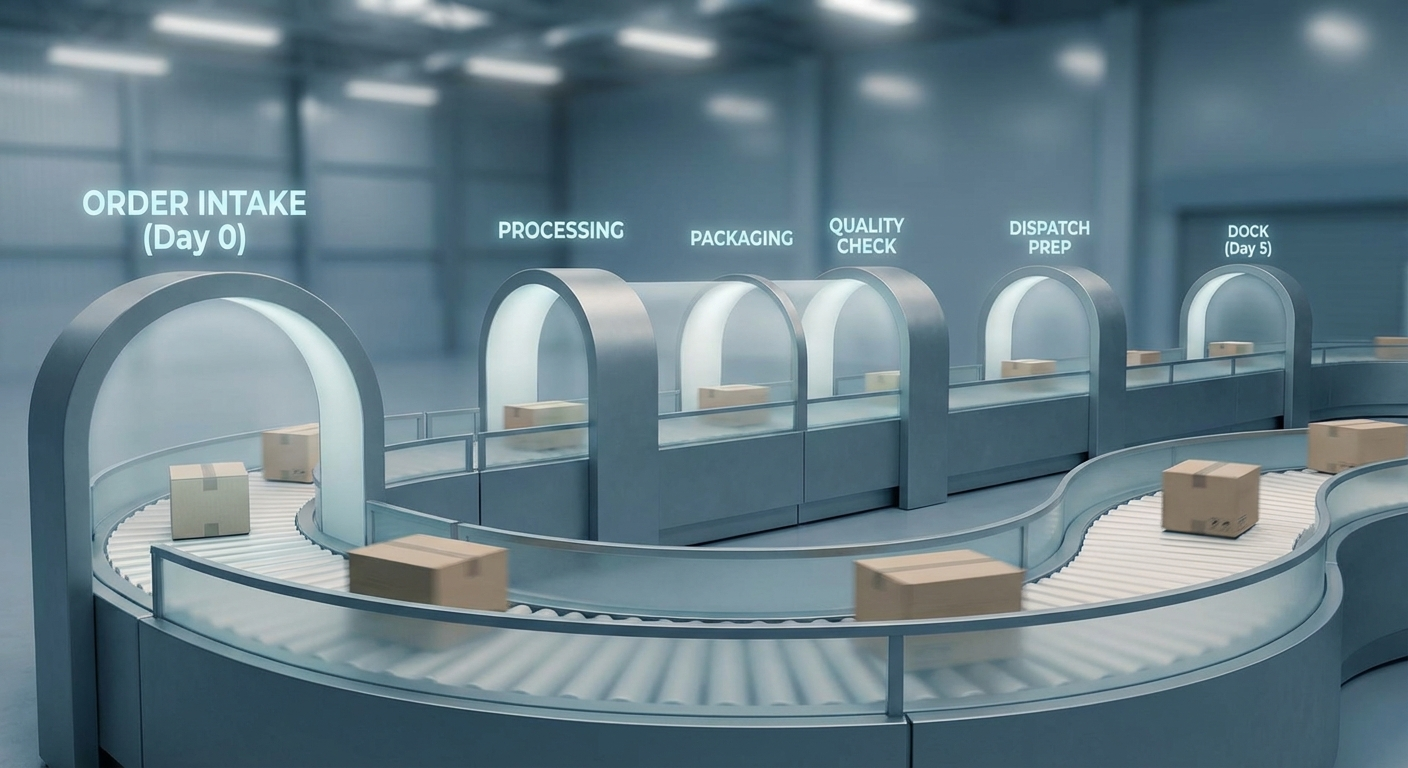
At All Points, we manage shipping cutoff times with precision and operational discipline. Our approach balances meeting delivery promises with internal efficiency to minimize errors and costs. Here’s how we work through the process every day:
1) Order Receipt: Orders arrive via API integration, EDI 940/945 transactions, or directly from ecommerce platforms. Ship methods normalize at this stage to prevent routing errors downstream.
2) Wave Planning and Batching: Orders are grouped daily by cutoff windows, ship method, and pick path. Batching optimizes picker travel paths by grouping like SKUs or multi-line orders by zone clusters. Priority waves, including expedited or marketplace SLA orders, are scheduled first to meet time sensitivity.
3) Pick Execution: Dedicated high-velocity SKU pick paths expedite the most popular products, while mixed orders undergo scan-verified picks to ensure accuracy. Exceptions, such as out-of-stock or address validation issues, are routed to resolution lanes before cutoff deadlines.
4) Pack and Quality Check: Packing stations are assigned based on wave and service levels. We use item-to-order and carton-to-label scans, weight verification, and include branded inserts or kitted bundles per SOPs to maintain quality and brand consistency.
5) Manifest and Staging: Label printing is grouped by carrier trailer, and cartons staged by route. We continuously monitor scan counts against pickup capacities and can add trailers if volumes spike near cutoff.
6) Carrier Handoff: Coordinated scheduled pickups include backup will-call options for contingencies. We monitor first scans closely to detect and remedy any missing or delayed shipments swiftly.
Learn more: https://www.allpointsatl.com/services/e-commerce-order-fulfillment
Shipping Cutoff Time KPIs and SLAs
These critical KPIs monitor cutoff performance and ensure your order fulfills promises reliably:
KPI | Target Metric | Notes
Pick Accuracy | ≥ 99.7% error free | Verified during QC and post-ship
On-Time Ship Rate | ≥ 98% | Orders shipped before cutoff
Order Cycle Time | ≤ 8 hours | From release to carrier handoff
Dock-to-Stock Time | ≤ 24 hours | From inbound receipt to picking
First-Scan Concurrence | ≥ 97% | Same-day tender and scan date
If your 3PL cannot consistently achieve these by wave and ship method, your storefront cutoffs will need to remain conservative until bottlenecks are resolved.

Pricing Drivers That Affect Shipping Cutoff Times
Extending cutoff times can increase operational costs due to labor complexity and resource constraints. Key pricing drivers include:
• Order Velocity and Volume Spikes: High order intake during peak hours (e.g., 4–8 pm) demands overlapping shifts or multiple last-day waves. During Q4 or sale events, prebuilt kits and forward staging can mitigate the burden.
• SKU Complexity and Pick Paths: Longer pick paths due to distributed SKUs or multi-touch packouts require extra time, either pushing cutoff earlier or inflating labor costs. Strategic slotting and pre-kitting help alleviate walking time and errors.
• Automation and Warehouse Management System (WMS) Discipline: Tools like scan-to-pack, weigh-in-motion systems, and put-to-light platforms reduce manual errors and speed processing, enabling later cutoffs with confidence. Conversely, poor data quality or WMS limitations increase overhead and error rates.
• Carrier Capacity and Proximity: Having multiple carriers and pickup points, especially in a hub like Atlanta, permits flexible late will-call options and prevents cutoff bottlenecks. Learn more: https://www.allpointsatl.com/services/warehousing-distribution
• Special Handling Requirements: Orders with hazmat items, temperature-sensitive goods, or signature-required deliveries typically necessitate earlier cutoff times due to complex packaging, staging, or carrier constraints.
Risks With Shipping Cutoff Times and How We Mitigate Them
Cutoff management presents operational risks that All Points addresses proactively:
• Early Storefront Cutoff (Too Conservative): Risk: Customers face lower conversions and abandoned carts when cutoff times exclude late-day purchasers. Mitigation: Smarter batching algorithms, adding late-day waves, and continuously analyzing first-scan data to incrementally push cutoffs later once consistent on-time rates ≥98% are reached.
• Late Storefront Cutoff (Too Aggressive): Risk: Missed pickups, broken promises, forced overnight shipping causing margin erosion. Mitigation: Align storefront cutoff with actual first-scan pickup data and carrier schedules, adding safety buffers of 30–60 minutes. Reference: https://www.ibm.com/docs/en/sip?topic=service-shipping-cutoff-times
• Labor Constraints and Shift Changes: Risk: Slowdowns or bottlenecks during peak load, errors due to fatigue. Mitigation: Overlapping shifts, express lanes for expedited orders, and heavier QC staffing during peak waves.
• Poor SKU Management: Risk: Pick errors, slowdowns caused by disorganized or unoptimized SKUs. Mitigation: SKU rationalization support, ABC slotting to optimize pick frequency, and frequent cycle counts to maintain accuracy.
• Carrier Delays or Missed Trailers: Risk: Same-day shipments scanned next day, breaking delivery promises. Mitigation: Backup carriers, on-call drivers, and will-call staging areas reduce risk.

The Atlanta Advantage in Shipping Cutoff Windows
Operating from Atlanta gives All Points and our clients a meaningful edge in cutoff flexibility and fulfillment speed:
• Atlanta’s ground services reach approximately 80% of U.S. addresses within two days, enabling competitive and flexible cutoff promises for DTC brands. This expansive reach reduces dependence on costly air freight.
• The region hosts a dense network of hubs from UPS, FedEx, USPS, and multiple regional carriers, providing multiple daily pickups and backup options to avoid missed trailers.
• Reduced ground transit time means shorter dock-to-stock and ship windows, which translates to later feasible cutoff times and fewer rushed shipments.
• We co-locate warehousing, custom kitting, printing, and fulfillment under one roof, removing internal handoff delays and accelerating processing speed.
Typical cutoff windows for Atlanta-based fulfillment operations are:
• Expedited Air: Storefront cutoff at 2–3 pm ET; warehouse release at 1–2 pm.
• Ground: Storefront cutoff at 4–5 pm ET; warehouse release at 3–4 pm.
• Economy / Postal Injection: Storefront cutoff at 12–2 pm ET; warehouse release at 11 am–1 pm.
These windows balance operational practicalities with customer expectations, as refined through years of serving the demanding Atlanta market.
Real-World Execution Tips to Set the Right Cutoff
Implementing cutoff times accurately depends on thorough data analysis and process discipline:
• Use first-scan and manifest data from the previous 30 days by carrier and service to identify practical cutoff windows.
• Aim for at least a 98% on-time ship rate to avoid needing costly last-minute overrides or upsetting customers.
• Separate waves strictly by service level—Ground, Air, and Postal Injection—to prevent cross-service bottlenecks.
• Pre-kit and pre-stage complex packs early in the day, freeing late-day waves to move faster.
• Protect the final hour before cutoff by avoiding new projects, training, or inbound receipt inflows that could distract warehouse teams.
• Consider time zone impacts and, where heavy West Coast demand exists, evaluate mirrored inventory or adjusted storefront cutoff messaging.
• Reflect accurate cutoff and delivery info on your PDP and checkout, e.g., “Order by 4 pm ET for same-day ship; orders after ship next business day,” aligned with your operational realities and customer expectations.
Further reading: https://dclcorp.com/blog/shipping/delivery-promise/
What You Get With All Points
Choosing All Points means entrusting your cutoff time performance to operational experts backed by technology and local carrier advantages:
• SOP-driven workflows keyed to your true cutoff performance and SLAs through ecommerce order fulfillment: https://www.allpointsatl.com/services/e-commerce-order-fulfillment
• Integrated kitting and assembly that remove last-minute complexities and delays in processing via custom kitting & product assembly: https://www.allpointsatl.com/services/custom-kitting-product-assembly
• Atlanta-based warehousing and distribution providing reliable late pickups, centralized operations, and broad two-day ground reach, supporting your evolving cutoff strategies with confidence: https://www.allpointsatl.com/services/warehousing-distribution
• Transparent KPIs—pick accuracy, on-time ship, first-scan concurrence—monitored by wave and ship method.
• A partnership mindset that values honesty over vague promises: if your catalog or order profiles don’t support a late cutoff window reliably, we work collaboratively to identify and eliminate bottlenecks before adjusting cutoff times.
Ready to Set Honest Cutoff Times and Improve Your Delivery Promise?
Get a kitting quote or talk to an Atlanta 3PL expert to optimize your shipping cutoff times and scale fulfillment accuracy.
Get a kitting quote: https://www.allpointsatl.com/request-free-quote/fulfillment-services
Download the free 3PL Guide: https://www.allpointsatl.com/resources/3pl-guide
FAQ
Q: What are typical shipping cutoff times in ecommerce fulfillment?
A: Storefront cutoffs commonly run 2–3 pm ET for expedited air, 4–5 pm ET for Ground, and 12–2 pm ET for economy/postal-injected services. Actual times vary based on carrier schedules, wave design, SKU complexity, and volume.
Q: How do cutoff times affect order accuracy and delivery?
A: Without disciplined cutoff windows, last-minute chaos increases mis-picks and missed pickups. Clean SKU data, tight wave planning, and staffed QC secure order accuracy and on-time delivery.
Q: Can All Points accommodate late-day shipping cutoffs?
A: Yes. We evaluate first-scan data, slotting, wave design, and carrier capacity. If we can maintain ≥ 98% on-time ship and ≥ 99.7% accuracy, we extend cutoffs confidently. Otherwise, we address bottlenecks first.
Q: What KPIs prove cutoff performance?
A: Critical metrics include on-time ship rate by wave/service, first-scan concurrence, pick accuracy, order cycle time, and dock-to-stock. We target ≥ 98% on-time ship and ≥ 99.7% pick accuracy consistently.
Q: How fast is shipping from All Points’ Atlanta location?
A: Ground service from Atlanta reaches approximately 80% of U.S. addresses within two days, minimizing reliance on air freight and enabling competitive cutoff promises.
Implementation Checklist
• Explicitly map storefront cutoff, warehouse release, and carrier pickup times.
• Validate cutoff times using first-scan data, not schedules alone.
• Separate waves by service levels, adding express late waves if feasible.
• Pre-kit complex SKUs and re-slot high-velocity SKUs to reduce pick distance and errors.
• Build carrier fallback plans, including backup trailers and will-call staging.
• Review KPIs weekly and only push cutoffs later after 2–4 stable weeks meeting targets.
Suggested Image Concept
A graphical timeline illustrating the daily “cutoff-to-pickup” workflow with exact timestamps: Order receipt → wave planning → picking → packing/QC → staging for carrier → carrier pickup.
Alt text: “Shipping cutoff times workflow for ecommerce fulfillment.”
Disclaimer
All Points is an Atlanta-based, family-owned 3PL founded in 1995. We deliver end-to-end logistics—from custom kitting and ecommerce fulfillment to warehousing, distribution, and printing—so your brand ships accurately, on time, and at scale.
Further Reading
https://oc3pl.com/shipping-cutoff-times-impact/
https://dclcorp.com/blog/shipping/delivery-promise/
https://www.ibm.com/docs/en/sip?topic=service-shipping-cutoff-times
https://www.loopreturns.com/blog/what-is-delivery-promise-why-does-it-matter/
https://weareprocarrier.com/news/article/a-retailers-guide-to-early-order-cut-off-times
All Points remains committed to empowering DTC brands with smart cutoff time strategies, streamlined ecommerce fulfillment, and deep Atlanta carrier networks—the foundation for a winning customer experience.
Conclusion
Master shipping cutoff times to boost your DTC brand’s fulfillment accuracy, reduce missed deadlines, and protect margins. Learn how operational discipline, carrier schedules, and smart wave planning ensure on-time delivery promises—plus how Atlanta’s logistics hub gives you a competitive edge.

.webp)
.webp)
.webp)
.webp)


