


Kitting Services: How They Work, What They Cost, and Why Packaging Matters
Fast-growing DTC brands and retail marketers depend on efficient kitting services to ship consistent, branded bundles without slowing down warehouse operations. Kitting combines multiple SKUs into custom kits that create compelling unboxing moments while maintaining operational speed, accuracy, and scalability. This guide explains when to use kitting, the kitting workflow (including standard operating procedures, or SOPs), critical pricing drivers, and key performance indicators (KPIs) and service level agreements (SLAs) to expect.
Beyond the assembly line, packaging plays an essential role in protecting products, reinforcing branding, and delighting customers. We cover how packaging impacts satisfaction, loyalty, and return rates, and why All Points’ Atlanta-based logistics hub supports faster delivery at a lower cost.

What Are Kitting Services and When Should You Use Them?
Kitting services are the process of bundling multiple individual items (SKUs) into pre-assembled sets, kits, or packages before shipment (e.g., subscription boxes, promotional packs, gift sets, starter kits, multi-SKU bundles). Instead of picking each component at order time, kitting assembles and verifies the set once, reducing packing time and errors.
Why Kitting Matters
Subscription Boxes & Recurring Orders: Consistent experience month after month; faster fulfillment and better accuracy for frequently changing assortments.
Promotional Bundles & Limited Editions: Tight version control and custom packaging management for seasonal or time-bound runs.
Multi-SKU Packaged Products: Tailored assembly for starter packs and refill kits to ensure all components are present and correct.
Packaging is also a storytelling tool: boxes, inserts, sleeves, and labels communicate brand quality and care at unboxing.
When to Outsource vs. Keep Kitting In-House
Keep In-House If: Fewer than 200 kits/day; low, stable kit variation; strict SOPs and inventory controls are consistently followed.
Outsource When: Versions change frequently; kits exceed ~5–7 SKUs and include many variations; you need daily batch runs from hundreds to thousands with consistent quality and timing; marketing needs frequent packaging/print/label changes that benefit from integrated printing and fulfillment.
All Points custom kitting and product assembly services: https://www.allpointsatl.com/services/custom-kitting-product-assembly

Kitting Workflow Step-by-Step (SOPs)
An efficient kitting program runs on strict SOPs to ensure accuracy, speed, and quality. Below is a typical workflow implemented at scale.
1. Receiving Components and Dock-to-Stock
Receive components with ASNs (piece counts; lot/expiry dates when applicable). Perform visual and barcode inspections for packaging condition and print accuracy (spot colors, variable data such as serial numbers). Put away to dedicated kit staging or high-velocity zones. Goal: dock-to-stock within 24 hours.
2. Assembly Staging and Layout
Use kit-specific BOMs and visual work instructions. Arrange workstations in SKU flow order (heavier/base items first; smaller components last). Use color-coded bins/shelves/carts to reduce search time and errors. Batch like kits to minimize changeovers and improve throughput.
3. Printing and Labeling Integration
Print sleeves, belly bands, inserts, and labels on-demand by run volume. Apply barcodes and version labels before/after assembly to prevent rework. Use scan-to-verify to catch mis-labels early, especially for serialized or variant-heavy SKUs.
Printing and marketing materials: https://www.allpointsatl.com/services/printing-marketing-materials
4. Batch Assembly
Typical batches: 100 to 1,000+ units depending on complexity and schedule.
Throughput benchmarks per line: 2–3 piece simple kits (250–400 kits/hour); 4–7 piece kits with inserts (120–250 kits/hour); complex/fragile kits (60–150 kits/hour).
Use jigs, trays, or guides to standardize placement and reduce seconds per unit.
5. Quality Control (QC)
Use multipoint QC: mid-line component counts, final unit weight confirmation, and barcode scans before packing. Require first-article approval on every kit or version change. Run hourly sampling audits to spot trends and SOP failures early.
6. Packing and Staging for Shipment
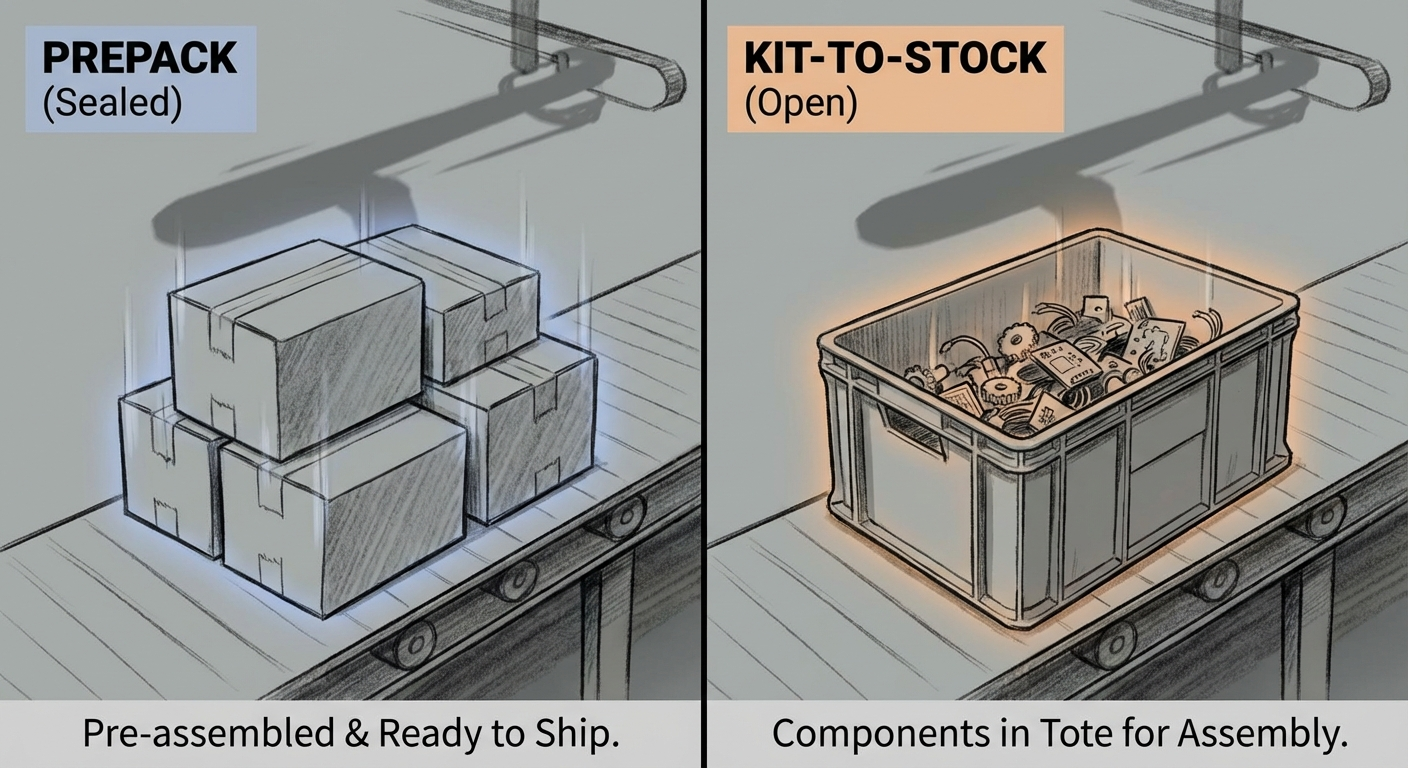
Prepack: Package into ship-ready cartons immediately after assembly for faster outbound processing, with higher storage volume.
Kit-to-stock: Store assembled kits unpacked and pack prior to shipment for flexibility, with an extra pack touch.
Apply channel-required labels (e.g., FNSKU/retail labels). Stage pallets/cartons with clear cutoffs by channel (DTC vs wholesale).
7. Daily Cadence and Controls
Daily stand-ups align labor with runs and order volumes. Lock BOMs before production; last-minute changes require controlled reprints/relabels. Monitor throughput and scrap rates per shift to identify jams and accuracy drift.

Key KPIs and SLAs for Kitting Services
KPI: Pick/kit accuracy | Typical SLA/Target: ≥ 99.5% | Why it matters: Minimizes costly order errors, returns, and inventory inaccuracy.
KPI: Order cycle time | Typical SLA/Target: 24–48 hours | Why it matters: Supports delivery promises and sales cadence.
KPI: Dock-to-stock time | Typical SLA/Target: Under 24 hours | Why it matters: Ensures inventory availability and fulfillment readiness.
KPI: On-time shipment rate | Typical SLA/Target: ≥ 98% | Why it matters: Builds trust and retention, especially for subscriptions.
KPI: Inventory accuracy | Typical SLA/Target: ≥ 99% | Why it matters: Avoids shortages and shipment errors.
KPI: Damage rate in transit | Typical SLA/Target: ≤ 0.5% (category-dependent) | Why it matters: Packaging quality drives this metric, affecting returns and reviews.
Pricing Drivers for Kitting Services
Labor Intensity: More components, fragile placement, and extra QC steps raise labor cost; specialized trays can increase packaging cost but reduce labor time and errors.
Volume and Batch Size: Higher volume and steady batches reduce changeovers and setup time; frequent micro-batches increase per-unit labor.
Packaging Customization and Print: Custom boxes, foil stamping, variable data, and multi-version sleeves raise cost but improve unboxing and reduce mis-kits.
Inventory Handling and Storage: Pre-packed kits use more cubic feet; kit-to-stock uses less space but adds a pack touch; high turnover reduces storage/carrying costs.
Automation versus Manual Assembly: Automation saves labor at scale but requires upfront investment; manual bench assembly is often best below certain volume thresholds.
Shipping Method and Zone Impact: Transportation often dominates cost; reducing DIM weight/cube lowers spend; Atlanta provides broad 2-day ground reach at lower transportation costs.
Warehousing and distribution: https://www.allpointsatl.com/services/warehousing-distribution

Packaging’s Impact on Customer Experience and Brand Loyalty
Packaging is often the first tactile and emotional touchpoint customers encounter. Its impact extends beyond protection to brand perception, satisfaction, and return rates.
Packaging as a Key Unboxing Touchpoint
Well-designed packaging increases perceived value, drives social sharing, and boosts repurchase rates. Sources: https://www.forbes.com/sites/cherylrobinson/2024/02/28/psychology-of-product-packaging-how-it-plays-into-profitability/ and https://www.packaging-gateway.com/features/how-packaging-design-drives-e-commerce-success/
Functional Design Reduces Errors and Returns
Trays, inserts, and color-coding guide assembly and reduce mis-picks. Snug custom fits reduce damage and improve perceived quality.
Branding Elements Drive Share-of-Wallet and Social Proof
Sleeves, insert cards, QR codes, and branded labels improve recall and sharing. Sources: https://www.creativedisplaysnow.com/how-packaging-influences-buying/ and https://sarpublication.com/media/articles/SARJBM_51_10-18_Qbw4yNY.pdf
Operation Risks if Packaging and Kitting Are Not Aligned
Frequent marketing updates without version control and SOP enforcement can cause mismatched kits, returns, complaints, and inventory confusion, requiring disciplined coordination between printing, kitting, and fulfillment.
Accessibility and Ease of Open Matter
Tear strips, minimal tape, and clear instructions reduce “packaging rage” and negative reviews while maintaining protection.
Bottom line: Cheapest packaging rarely yields the lowest total cost; design for assembly speed, protection, and brand clarity.
Unboxing satisfaction score reference: https://www.alexanderjarvis.com/what-is-unboxing-satisfaction-score-in-ecommerce/
Risks and How All Points Mitigates Them
Inventory Inaccuracies
Risk: Wrong component counts stall batches or cause shortages leading to late shipments or incomplete kits.
Mitigation: Dock-to-stock within 24 hours, barcode scanning on all moves, and frequent cycle counts on kit-critical SKUs.
SKU Sprawl and Version Control
Risk: Duplicate/near-duplicate SKUs cause confusion, mis-picks, and reassignment costs.
Mitigation: SKU governance, sunset policies for old kits, and logical SKU naming for fast identification.
Custom Print Errors
Risk: Misprints or wrong versions force reprints and delay shipments.
Mitigation: Print proofs, first-article sample approval, and on-site print realignment for fast correction.
Scaling Too Fast Without SOP Discipline
Risk: Rushed hiring and last-minute changes increase errors and disrupt throughput.
Mitigation: Line balancing, locked BOMs, comprehensive SOPs, cross-trained surge floaters, and selective automation when ROI justifies it.
Last-Minute Marketing Changes
Risk: Late sleeve/insert changes cause version mismatches and customer confusion.
Mitigation: Strict change control windows to protect accuracy and on-time SLAs.
Atlanta Advantage for Kitting and Ecommerce Fulfillment
2-Day Ground Reach to ~80% of U.S. customers: Faster delivery without costly air freight.
Lower transportation costs vs. coastal 3PLs: Reduced zones, distance, fees, and transit time.
Ideal for national subscription box launches and promo kits: Predictable replenishment cycles and parcel pickups.
Decades of operational experience: All Points operates in Atlanta since 1995 with integrated services.
Integrated printing and kitting under one roof: Fast turnarounds and flexibility for packaging changes.
E-commerce order fulfillment: https://www.allpointsatl.com/services/e-commerce-order-fulfillment
What You Get with All Points
Custom kitting tailored to brand and SKU complexity for accuracy and scale.
Integrated printing and marketing materials (sleeves, inserts, labels) synchronized with kit runs.
Operator-grade execution with SOPs, QC gates, and KPI tracking for continuous improvement.
Atlanta-based network for fast ground shipping, cost efficiencies, and scalable infrastructure.
Transparent communication and partnership with realistic commitments and collaborative improvement.
Custom kitting and product assembly: https://www.allpointsatl.com/services/custom-kitting-product-assembly
Printing and marketing materials: https://www.allpointsatl.com/services/printing-marketing-materials
Call to Action
Get a kitting quote today: https://www.allpointsatl.com/services/custom-kitting-product-assembly
Secondary CTA: Download the 3PL Guide for e-commerce and Amazon sellers: https://www.allpointsatl.com/resources/3pl-guide-for-e-commerce-and-amazon-sellers
FAQs
1. What is included in All Points kitting services?
Receiving components, barcode-driven inventory control, staged visual assembly with SOPs, integrated printing and labeling, multipoint QC checks, and final packing/staging for shipment, including pre-packed ship-ready cartons or kit-to-stock flexibility.
2. How does packaging affect kitting costs?
Complexity and custom print increase upfront labor/materials, but can reduce errors and damage, speed assembly, enhance brand image, and lower total cost via fewer returns and higher satisfaction.
3. What are typical SLAs for kitting order fulfillment?
Targets include ≥99.5% pick accuracy, 24–48 hour order cycle times, dock-to-stock within 24 hours, and ≥98% on-time shipment rate, supported by channel cutoffs and daily reporting.
4. Why choose an Atlanta-based 3PL like All Points for kitting?
Atlanta provides 2-day ground reach to ~80% of the U.S. at lower shipping costs; All Points combines operator-led kitting and integrated printing since 1995 for on-time, branding-consistent shipments.
5. How does All Points handle volume spikes in kitting?
Disciplined batch management, cross-trained surge teams, locked BOMs before runs, SOP adherence, and controlled workarounds to protect accuracy and SLAs.
Sidebar Module
Based in Atlanta since 1995
Phone: [Insert phone number] | Email: [Insert email]
Talk to an Atlanta 3PL expert: https://www.allpointsatl.com/contact
Disclaimer
This article provides operational insights on kitting services offered by All Points. Service levels, pricing, and workflows vary by client and industry. For detailed consultations and customized quotes, contact All Points directly.
Conclusion
Discover how efficient kitting services streamline DTC fulfillment by bundling SKUs into custom kits that boost accuracy, speed, and brand impact. Learn key workflows, cost drivers, packaging’s role in customer loyalty, and why Atlanta-based All Points offers scalable, integrated solutions for flawless kitting and fast delivery.
.webp)
.webp)
.webp)
.webp)
.webp)


