


.webp)
Choosing the right California fulfillment services provider is a high-stakes decision for DTC brands and retail marketers. California offers unmatched market access and West Coast delivery speed, but those advantages come with complex tax exposure, higher operating costs, and a crowded 3PL landscape.
This guide explains how California fulfillment actually works—covering workflows, pricing drivers, SLAs, and operational risks—so you can evaluate 3PLs and kitting partners with confidence. It also outlines when an Atlanta-based or hybrid fulfillment strategy can outperform a California-only setup.
With national networks like ShipBob and ShipHYPE expanding their California footprints, alongside regional specialists such as Promofill and Speed Commerce, understanding the fundamentals matters more than ever.
.webp)
What Are California Fulfillment Services and When to Use Them?
Definition:
California fulfillment services refer to third-party logistics (3PL) providers specializing in warehousing, pick and pack, ecommerce order fulfillment, returns management, kitting, and shipping optimization specifically for inventory stored in California. They serve brands selling into or storing inventory in California or serving West Coast customers where fast, local shipping is a priority.
When to Use California Fulfillment Services:
California fulfillment services refer to third-party logistics (3PL) providers that manage warehousing, pick and pack, ecommerce order fulfillment, returns, kitting, and shipping optimization for inventory stored within California.
These services are typically the right fit when your business meets one or more of the following conditions:
Brands selling heavily into California benefit from shorter delivery windows and improved customer experience when inventory is positioned in-state. Companies storing inventory within California—either in their own facility or a 3PL’s—must comply with state sales and use tax rules enforced by the California Department of Tax and Fee Administration. For West Coast customers in metros like Los Angeles, San Francisco, and San Diego, local fulfillment reduces parcel transit time and zone-based shipping costs.
California 3PLs are also frequently selected for brands that need specialized kitting, branded inserts, or in-house print capabilities. Keeping these services under one roof minimizes freight handoffs and maintains packaging consistency. Retail and marketplace programs with strict SLAs often rely on West Coast distribution hubs to handle volume spikes and seasonal demand.
Types of California Fulfillment Providers:
National networks operate multi-node fulfillment infrastructures with California locations, offering standardized technology and scalability. Regional specialists focus primarily on California and adjacent markets, often delivering more customized service or vertical expertise. Local and niche operators serve specific industries or provide specialized packaging, kitting, or print services within a limited geographic footprint.
Each model has tradeoffs. Scale and software depth often favor national providers, while customization and responsiveness are strengths of regional or niche 3PLs.
Regulatory note: Storing inventory in California establishes nexus. Accurate, transaction-level inventory reporting from your 3PL is essential to remain compliant and audit-ready.
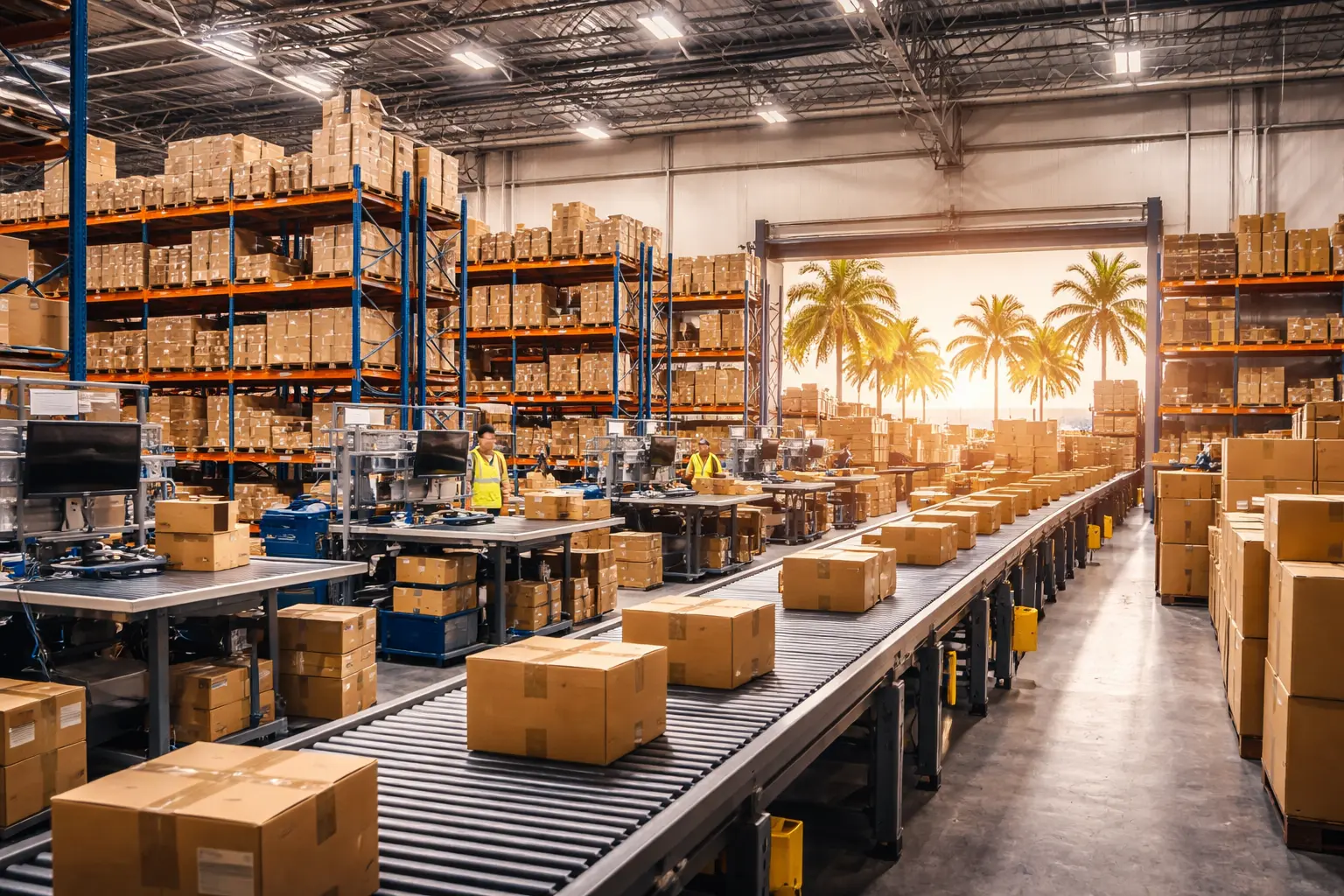
Step-by-Step Workflow of California Fulfillment Services
Understanding a California fulfillment provider’s operational workflow clarifies how your orders move through the system and where value is added.
Inbound Receiving
- Inventory arrives via pallet, parcel, or bulk shipment, typically supported by an ASN
- Teams unload, count, inspect for damage, and validate SKUs against purchase orders
- Discrepancies are documented with photos
- Best-in-class operators target dock-to-stock within 24 hours
Inventory Management
- Inventory is tracked in a WMS with real-time visibility by SKU and location
- Cycle counts and audits protect against overselling and shrink
- Lot, serial, or expiration tracking may be required for regulated products
- Replenishment rules keep forward pick locations stocked for speed
Order Processing & Pick / Pack
- Orders flow in from ecommerce platforms, marketplaces, or EDI connections
- Picks are batched for efficiency and verified via barcode scanning
- Packing follows documented SOPs for protection, branding, and compliance
- Inserts, gift notes, and required labels (including Prop 65 warnings) are applied here
Custom Kitting & In-House Printing
- Multi-SKU kits are assembled according to BOM requirements
- QA checkpoints validate count, sequence, and presentation
- Branded inserts, postcards, and marketing collateral are printed on-site
- Integrated operations reduce lead times and freight handoffs
Compliance & Tax Data Preparation
- Inventory and transaction data is exported to support CDTFA reporting
- Returns and location-level inventory changes are tracked for audit trails
- Clean data feeds help tax engines calculate California nexus correctly
Shipping & Returns Management
- Carrier selection is optimized by cost, speed, and service level
- Amazon FBA prep follows strict routing and labeling requirements
- Returns are inspected and dispositioned: restock, refurbish, or scrap
- Inventory updates in real time to prevent sellable stock errors
Reporting & Performance Management
- Providers report on order cycle time, on-time shipping, and accuracy
- KPIs are reviewed regularly to drive continuous improvement
- SLAs define corrective action if performance thresholds are missed
For fast, accurate ecommerce order processing, consider our ecommerce fulfillment services.
California Fulfillment SLAs and KPIs to Expect
Selecting a 3PL with clear SLAs ensures predictable performance vital to customer satisfaction.
.webp)
Why SLAs Matter:
SLAs create agreed-upon expectations and offer recourse when service dips. Good 3PL contracts include credit policies or corrective action plans if KPIs aren’t met. Confirm how order cut-off times, holiday schedules, and blackout dates impact SLAs to avoid surprises during peak seasons.
Pricing Drivers for California Fulfillment Services
Pricing for California fulfillment reflects regional market dynamics and service complexity. Key drivers include:
- Storage Fees: California’s high warehousing real estate and labor costs translate to higher storage fees, billed by the pallet, bin, or cubic foot. Optimizing volume and pallet utilization can reduce per-unit cost.
- Pick & Pack Charges: Labor intensity depends on order complexity—multi-SKU orders, fragile items, and special packaging steps increase charges. Clear tiered pricing distinguishes single-SKU from multi-SKU order fees.
- Kitting & Customization: Assembly costs vary by number of SKUs per kit, QA rigor, and the inclusion of printed collateral. Hourly or per-unit rates apply. Proper BOM alignment streamlines workflows and controls cost.
- Shipping Costs: Determined by zone, weight, dimensions, and carrier choice. California’s location is ideal for West Coast shipping but less cost-effective for the East Coast. Leveraging regional carriers and dimensional weight optimization is critical.
- Compliance & Tax Handling: Some 3PLs include California tax reporting support; others bill separately for tax data exports or nexus consulting. Clarify these fees before onboarding.
- Projects & Receiving: Special projects like labeling, lot tracking, or product inspections often incur additional fees, so obtain detailed rate cards and turnaround expectations upfront.
Risks and Mitigations When Using California Fulfillment Providers
Operating within California’s complex fulfillment environment carries risks:
Unexpected Tax Liabilities or Registration Issues:
Risk: Inventory held in California may trigger tax nexus, incurring liability from unregistered or misapplied tax.
Mitigation: Partner with 3PLs experienced in CDTFA compliance, supplying detailed inventory and transaction data. Engage tax specialists and ensure software integration with tax engines is accurate.
Delays Due to Congested Ports or Warehouse Bottlenecks:
Risk: Port delays or warehouse overloads during peak seasons can slow dock-to-stock or shipping.
Mitigation: Negotiate dock-to-stock SLAs, confirm inbound dock appointment processes, and obtain contingency plans from your 3PL.
Inventory Inaccuracies During High Volume:
Risk: Stock discrepancies increase during sales spikes due to scan errors or process breakdowns.
Mitigation: Require regular cycle counts, strict SOPs, bin-level scanning, and variance reporting from your 3PL.
Overpayment for Kitting/Assembly Without Quality Control:Risk: Pay more for kits that don’t meet quality expectations or cause rework.
Mitigation: Choose providers offering integrated printing and kitting under one roof with documented QA protocols. Request first-article approvals and ensure packaging SOPs include photographic evidence.
Poor Data Integration & Latency Affecting Order Accuracy:
Risk: Slow or unreliable system integrations lead to dispatch errors and inventory mismatches.
Mitigation: Perform thorough integration testing between your ecommerce platform and the WMS. Run parallel order processing before going live and clarify synchronization cut-off times.
The Atlanta Advantage Compared to California Fulfillment
While California fulfillment strategically serves the West Coast, brands shipping nationally can benefit from incorporating fulfillment centers in other hubs. Atlanta is one such compelling alternative.
Key Advantages of Atlanta-Based Fulfillment via All Points:
- Speed: All Points’ Atlanta network reaches approximately 80% of U.S. consumers in two days via ground transit. This outperforms many California-only setups for East Coast and central U.S. destinations, offering faster coast-to-coast service at competitive prices.
- Cost Efficiency: Atlanta’s warehousing and labor costs are generally lower than California’s, resulting in total landed cost savings. Balanced outbound parcel zones from Atlanta optimize nationwide shipping compared to single-node West Coast fulfillment.
- Integrated Services: With custom kitting, printing, ecommerce fulfillment, warehousing, and distribution co-located in Atlanta, All Points reduces lead times, freight touches, and data handoffs — improving quality and control.
- Experience: A family-owned 3PL since 1995, All Points combines operator-grade execution with documented SOPs, transparent KPIs, and SLA-backed guarantees designed for accuracy and scalability.

What You Get with All Points
- End-to-End Logistics: We deliver ecommerce order fulfillment, warehousing and distribution, integrated custom kitting, and in-house printing — all designed to accelerate speed to market while reducing defects and costs.
- Explore our ecommerce fulfillment services
- See our warehousing and distribution capabilities
- Build brand-right packs with custom kitting and assembly
- Maintain packaging and brand consistency through printing and marketing materials - Operator-Grade Execution: SOPs include barcode scan compliance, rigorous QC checkpoints, and KPI reporting on inventory accuracy, order cycle time, and on-time ship rates.
- Tax and Compliance Support: We deliver clean, detailed data exports to support your California and multistate tax filings with CDTFA and other authorities.
- Onboarding That Sticks: Our dedicated project management team ensures comprehensive onboarding, test orders, and first-article approvals for seamless go-live.
Frequently Asked Questions
Q: What are the typical pricing components of California fulfillment services?
A: Pricing usually includes storage fees (pallet/bin/cubic foot), pick and pack charges tiered by SKU count, kitting and assembly costs (per-unit or hourly), inbound receiving and special projects, shipping fees dependent on zone and weight, and optional CDTFA compliance/reporting fees.
Q: How long does it take a California 3PL to process orders?
A: Standard SLAs target same-day or next-business-day order processing for orders placed before cut-off times, resulting in a 24–48 hour order cycle time. Confirm weekday vs. weekend operations and peak season contingencies with your provider.
Q: How does a 3PL handle California sales tax compliance?
A: Though your tax engine manages filings, the 3PL must supply accurate, location-specific inventory and order/return data with audit trails. Storing inventory in California creates nexus and filing obligations with CDTFA.
Q: What KPIs should I require from a California fulfillment partner?
A: Essential KPIs include inventory accuracy (≥99.5%), pick accuracy (≥99.8%), dock-to-stock time (≤24 hours), on-time shipping rate (≥98%), and order cycle time (24–48 hours). Monthly performance reporting and corrective action plans should be part of SLAs.
Q: Why consider fulfillment outside California, such as Atlanta?
A: Atlanta offers faster transit to about 80% of U.S. households within two days ground, balancing outbound parcel zones and lowering costs for national brands. Many companies blend Atlanta fulfillment with a West Coast node for hybrid efficiency.
Conclusion
Explore California fulfillment services—covering workflows, pricing, SLAs, and tax compliance—and discover when regional 3PLs or Atlanta-based fulfillment offer advantages. This guide equips brands to navigate complex rules and optimize logistics for fast, cost-effective West Coast and national delivery.

.webp)
.webp)
.webp)
.webp)


